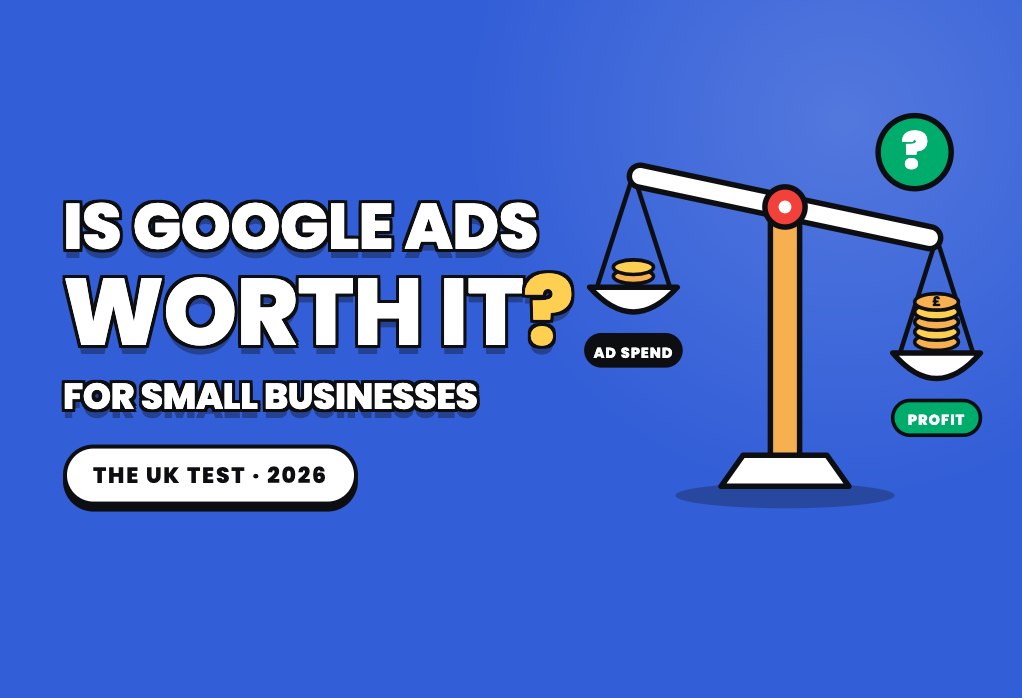
“Is Google Ads worth it?” is the wrong question, and it is why so many small businesses try it, lose £1,000 and give up. Google Ads is not good or bad. It is a machine that buys customers at a price. Whether it is worth it for your business comes down to three numbers you already know, one setting most people never change, and whether you give it long enough to learn. This guide gives you the test, the maths, a calculator and the exact budget thresholds, using UK prices and real account data.
Short answer: Google Ads is worth it for a small business when people are already searching for what you sell and the profit from one customer is bigger than what it costs to win one. Multiply your profit per customer by your website conversion rate and your close rate. If the answer is higher than the cost per click in your market, Google Ads can pay. Most UK small businesses need about £750–£1,500 a month and 60–90 days to know for sure.
Figure 1 · The 3-number test: the most you can afford to pay per click
Illustrative local service business. Pay less per click than your break-even figure and every customer is profitable. Pay more and no amount of “optimisation” will save it.
01The honest answer: yes, but only for some businesses
Google Ads is the only marketing channel that puts you in front of someone at the exact moment they type what they want into a search box. That is why it can work so fast for small businesses. A boiler breaks, someone searches “emergency boiler repair Leeds”, and the plumber with a well-run ad gets the call that afternoon. No other channel matches that intent.
It is also why it fails. Google charges for every click whether or not that person buys, and the default settings are built to spend your budget, not protect it. For a small business, Google Ads tends to be worth it when four things are true:
- People already search for it. If nobody types your product or service into Google, there is nothing to bid on. New inventions and unknown categories usually need demand creating first.
- One customer is worth enough. A £40 one-off sale struggles to pay for £3 clicks. A £150 job, a £2,000 treatment or a customer who reorders for years can easily cover them.
- Your website or phone converts. Ads bring people to the door. If the page is slow or the phone goes to voicemail, the money is gone.
- You can fund the learning period. The first weeks are partly about finding which searches make money. A budget that runs out before then proves nothing.
If you tick all four, Google Ads is usually the fastest-paying channel a small business can buy. If you tick two or fewer, you are better off fixing those first. The scorecard in section 11 turns this into a number.
02The 3-number test: will Google Ads pay for your business?
Every profitable Google Ads account obeys one rule: the cost of winning a customer must be lower than the profit that customer brings. You can test this before spending a penny, using three numbers you already know.
Cost per customer = cost per click × 1.02 ÷ (conversion rate × close rate)
POAS = profit per customer ÷ cost per customer (above 1.0 = profitable)
- Profit per customer is what you keep after materials, labour, delivery and refunds, not the sale price. If customers come back, use the profit across their first year.
- Website conversion rate is the share of ad clicks that call, fill in a form or buy. For an ecommerce store with no sales step, set the close rate to 100%.
- Close rate is the share of enquiries your team turns into paying customers.
- The × 1.02 covers Google’s 2% UK Digital Services Tax fee, which is added to invoices for ads shown in the UK and is left out of almost every calculator online.
Is Google Ads worth it? Your numbers
Your result
Estimates only. Real click costs vary by keyword, area and competition, and rise as you scale.
The calculator shows why two businesses in the same town can reach opposite answers. A locksmith with £90 profit per job, a 15% conversion rate and a 70% close rate can afford £9.45 a click. An online gift shop with £12 profit per order and a 2% conversion rate can afford 24p. Same platform, same town, completely different verdict. To find real click prices for your keywords, use Google’s free Keyword Planner, and see our complete guide to Google Ads costs in 2026.
⌁ The insight most guides miss
You have three levers, and the cost per click is the one you control least. Lifting your website conversion rate from 5% to 10% doubles your break-even click price overnight. Most small businesses that “can’t afford Google Ads” actually have a landing page problem, not a budget problem.
03How much should a small business spend on Google Ads?
Enough to collect real data, and no more until it proves itself. Google’s automated bidding learns from conversions. As a working rule, it needs roughly 30 or more conversions a month in a campaign before it can bid with any confidence. Below that, results swing wildly from week to week and you cannot tell a bad month from a bad strategy.
Example: 30 enquiries × £3 × 1.02 ÷ 10% = £918 a month
Figure 2 · The budget ladder: enquiries per month at £3 a click
Illustrative: £3 average click, 2% UK DST fee, 10% of clicks enquire. Real costs rise as you scale, so treat the top bars as a ceiling, not a promise.
| Monthly budget | Clicks | Enquiries | Customers (40% close) | What this budget can do |
|---|---|---|---|---|
| £300 (£10 a day) | 98 | 10 | 4 | Too thin to learn. Fine for one tightly targeted local service. |
| £750 | 245 | 25 | 10 | A real test with manual bidding and exact keywords. |
| £1,500 | 490 | 49 | 20 | Enough data for smart bidding on enquiries. |
| £3,000 | 980 | 98 | 39 | Room to test offers, areas and ad copy. |
| £5,000+ | 1,634 | 163 | 65 | Where specialist management usually pays for itself. |
Same assumptions as Figure 2. At £150 profit per customer, every row is profitable on paper. In practice the last pounds of each budget return less, as our guide to why ROAS can be high while profit is low explains with marginal returns.
Can you run Google Ads on £10 a day? Yes, if you shrink the target to match. Pick one service, one town and a handful of exact-match, high-intent keywords like “emergency electrician Bolton”, and switch everything else off. £10 a day spread across a whole county and twenty services buys a little bit of everything and teaches you nothing.
04Is yours a “Google Ads business”?
Two questions decide which channel should come first: are people already searching for what you sell, and how much is one customer worth? Plot your business on the grid below.
Figure 3 · The channel-fit matrix
Placements are typical, not fixed. A takeaway with a loyal repeat base moves up; a solicitor in a tiny niche may move left.
- Top right, the sweet spot. High-intent, high-value services: private dental, aesthetics, legal, solar and heat pumps, home improvements, B2B software. This is where we see the strongest returns, and where our dental clinic, aesthetics clinic, home energy, home services and SaaS PPC playbooks live.
- Top left, create demand first. Valuable but unknown. Nobody searches for a product they have never heard of, so Meta Ads usually goes first to build awareness, with Google Ads catching the brand searches that follow.
- Bottom right, tightly controlled. Lots of searches, thin margins. Google Ads can work here, but only with product-level control, which is the core of ecommerce PPC management.
- Bottom left, not yet. Build your Google Business Profile and local SEO first, and come back to paid ads when the numbers change.
05Where small-business Google Ads budgets leak
Most small businesses that say “Google Ads doesn’t work” never actually ran Google Ads properly. They ran Google’s default settings. Here is a typical breakdown of where the first £1,000 goes in a self-built account.
Figure 4 · Where the first £1,000 goes in a default-settings account
Illustrative composite of a first-month, default-settings Search campaign. Your mix will differ, but the same five buckets appear in almost every unmanaged account.
The 10 settings that decide whether Google Ads works for you
- Untick the Display Network and Search Partners in Search campaigns. When you create a new Search campaign they are switched on by default, and they send your ads to websites and apps instead of Google search.
- Change location targeting to “Presence”. The default, “presence or interest”, shows ads to people who have merely shown interest in your area. A Bristol roofer does not want clicks from Dundee.
- Build a negative keyword list on day one. Start with:
jobs,salary,course,training,free,DIY,how to,youtube,second hand. Then check the search terms report weekly. - Start with exact and phrase match. Broad match can work, but only once conversion tracking is feeding it real results. Without data it guesses, expensively.
- Track calls and forms before you spend. If Google cannot see which clicks became enquiries, it cannot find more of them. Phone calls are often the majority of small-business leads.
- Turn off auto-applied recommendations. Many recommendations raise budgets or broaden targeting. Review them, do not let them apply themselves.
- Send each ad to the page that matches it. An ad for “boiler servicing” should land on the boiler servicing page, not your homepage.
- Schedule ads for when you can answer. If calls at 10pm go to voicemail, stop paying for clicks at 10pm.
- Ignore Google’s suggested budget. Set your own from the formula in section 3.
- Add the 2% UK DST fee to your maths. It is charged on top of click costs and quietly raises every cost per lead.
For campaigns that are spending but not converting, see our 14 fixes for Performance Max, and for the bigger picture, our winning Google Ads strategies for 2026. If a WhatsApp chat converts better than a phone call for your customers, the Google Ads WhatsApp extension guide shows how to add it.
Already running Google Ads and not sure it’s working?
Our paid PPC audit checks these exact settings, your tracking and your wasted search terms, and tells you whether your account can pay back.
06Google Ads vs Meta Ads vs SEO for small businesses
Google Ads is rarely the only answer. Each channel does a different job, and the best small-business marketing plans use two or three in a deliberate order.
| Channel | Best at | Speed | You pay for | Small-business fit |
|---|---|---|---|---|
| Google Search Ads | Catching people ready to buy now | Days | Clicks | Strongest when demand already exists |
| Local Services Ads | Calls for selected local trades | Weeks (verification) | Leads | Excellent if your category is eligible |
| Meta Ads | Creating demand people didn’t know they had | Days | Impressions | Strong for visual products and lead forms |
| SEO | Free, compounding traffic | Months | Time and content | Essential long term, too slow to rely on alone |
| Google Business Profile | Local map listings | Weeks | Nothing | Do it first, whatever else you do |
Google Ads vs Facebook Ads: Google answers demand, Meta creates it. A dentist offering implants will usually find Google Ads faster because people search for “dental implants near me”. A new skincare brand will usually find Meta Ads faster because nobody searches for a brand they have never seen. For lead generation, Meta’s instant forms can produce leads very cheaply, as our Manchester real estate case study shows (1,213 leads, best cost £16.12), though lead quality needs watching. Our comparison of lead ads vs landing pages covers that trade-off, and the Meta Ads optimisation playbook covers the rest.
Google Ads vs SEO: not either-or. Ads buy you results this month while SEO builds the asset that lowers your costs next year. The search terms report in Google Ads is also the best SEO keyword research a small business can get, because it shows exactly which phrases turn into customers.
Search is changing too. AI answers now take space at the top of many results, and new ad formats are appearing inside AI assistants. Our guides to ChatGPT Ads in the UK and the TIEBREAK framework explain when those are worth testing, and the Google Ads updates tracker logs every platform change as it lands.
07What real results look like (and why they took work)
Talk is cheap in this industry, so here are two Google Ads accounts we manage, both confirmed by the clients in verified reviews on Clutch.
A small budget returned £13.26 in conversion value for every £1, with 230 conversions at £2.43 each.
Read the case study → Google Ads · Cosmetics brand 15 → 299From 10–20 conversions a month to 299 at a 13.59× ROAS, using Shopping and Performance Max.
Read the case study →The first result matters most for small businesses: £561 of spend in a month is a small-business budget. It worked because the account bid only on conversions that mattered, not every action on the website. That is the same principle behind how our system works: feed Google your real sales data, and it bids for customers instead of clicks. You can see every result in our Google Ads and Meta Ads case studies.
⚠ Be wary of guaranteed results
No one controls Google’s auction, so no honest agency can guarantee leads, page-one positions or ROAS before seeing your numbers. What can be promised is a process: clean tracking, tight targeting and decisions based on profit.
08The first 90 days: what to expect, and when to stop
The biggest reason small businesses conclude Google Ads “doesn’t work” is judging it in week two. Here is a realistic timeline for a new account.
Set up and collect data
Tracking live, settings fixed, first search terms arriving. Expect volatile results. Do not judge the channel yet.
Clean the traffic
Add negative keywords weekly, pause keywords that spend without converting, and improve the pages that get clicks but no enquiries.
Let the data steer
With enough conversions, move to automated bidding on cost per lead or value. Shift budget towards the services and areas that win.
Decide: scale, fix or stop
You now have real numbers for the 3-number test. Scale if cost per customer is below your break-even. Fix if it is close. Stop if it is far off.
▸ The stop rule
If you have bought around 300 clicks on high-intent keywords with tracking working and still have no customers, stop raising bids. At a 3% conversion rate you would expect about 9 enquiries from 300 clicks, so zero means the problem is your offer, price, website or phone handling, not the ads. Fix that first, then restart.
09DIY, freelancer or Google Ads agency in the UK?
Who runs the account matters as much as the budget. Here is an honest breakdown, including when hiring us would be the wrong choice.
| Option | Best for | Watch out for |
|---|---|---|
| Do it yourself | Budgets under about £1,000 a month, one service, one area | Default settings, no time to check search terms weekly |
| Freelancer | Budgets of roughly £1,000–£5,000 with a simple setup | Reports full of clicks and impressions instead of sales |
| Specialist Google Ads agency | £5,000+ a month, high-value customers, multiple services or areas | Long contracts, junior staff, no access to your own account |
Management is usually priced as a percentage of ad spend (often 10–20%) or a flat monthly fee. Whatever you choose, you should always own the Google Ads account.
We are honest about our own fit. Our Google Ads management is built for UK businesses where one customer is worth hundreds or thousands of pounds and ad spend is around £5,000 a month or more. Below that, the management fee eats too much of the return, and you are usually better off running the account yourself with the settings in this guide. When you do hire a Google Ads agency in the UK, ask these five questions first:
- Will I own the Google Ads account and all its data?
- Will you report on cost per customer and revenue, or on clicks and leads?
- Who will actually manage my account day to day?
- How will you track phone calls and offline sales?
- What is the notice period if it doesn’t work?
Our answers are on About Global PPC and in the profile of our founder, Hassan Tahir, who leads strategy on every account.
10UK-specific costs, credits and locations
The 2% UK DST fee
Google adds a 2% UK Digital Services Tax fee to invoices for ads shown in the UK. It appears as a separate line on your invoice, not in the cost column of the campaigns. On a £1,500 monthly budget, that is £30 a month most small businesses never budget for. It also applies to ads shown in the UK to people who only showed interest in your area, which is one more reason to use “presence” location targeting.
New-advertiser credit
Google often offers new advertisers promotional credit: you spend a set amount within 60 days, Google verifies you are genuinely new (which can take up to 35 days), then adds credit that typically must be used within 60 days. The credit cannot cover the spend requirement itself, and amounts vary by country and offer. It is worth claiming, but never let a credit decide your budget or your timeline.
Local Services Ads for trades and professional services
For selected service categories in the UK, Google’s Local Services Ads appear above normal ads and charge per lead rather than per click, with a verification badge for eligible businesses. Availability depends on your category and area, so check eligibility before you plan around them. Where they are available, they often suit small local firms better than standard Search ads.
London vs Manchester vs the rest of the UK
The same keyword can cost very different amounts by city. Competition in central London is typically fiercer than in Manchester, Leeds, Birmingham or Glasgow, so a London small business often needs a higher profit per customer to pass the 3-number test. The fix is not to avoid London but to target it precisely: specific boroughs or postcodes rather than “London”, ad schedules that match when you can take the work, and bid adjustments for the areas that actually convert. Pull the location report after 30 days and you will usually find a few postcodes producing most of your profitable customers.
11The worth-it scorecard
Answer yes or no to each statement. Count the yeses.
People search Google for my service or product by name (check in Keyword Planner).
My profit per customer is at least £100, or customers come back to buy again.
The calculator above shows a break-even CPC higher than real click prices.
I have a dedicated page for each main service, and it loads fast on mobile.
Someone answers the phone and replies to enquiries within an hour.
I can track which enquiries and sales came from ads.
I can commit at least £750 a month for 90 days without it hurting cash flow.
I can take on more customers next month without turning work away.
⌁ The rule to keep
Google Ads is worth it when you know what a customer is worth, you track what they cost, and you give the account long enough to learn the difference. Everything else is detail.
Frequently asked questions
Is Google Ads worth it for a small business in the UK?
Yes, when people already search for what you sell and the profit from one customer is higher than the cost to win one. Multiply profit per customer by website conversion rate and close rate. If the result is above the cost per click in your market, Google Ads can be profitable. Most UK small businesses need £750–£1,500 a month and 60–90 days to know for sure.
How much should a small business spend on Google Ads per month in the UK?
Enough to get around 30 conversions a month so the account can learn. A simple formula is target conversions × cost per click × 1.02 ÷ conversion rate. At £3 a click and a 10% conversion rate, that is about £918 a month. Many UK small businesses start between £750 and £1,500 a month.
Can I run Google Ads with £10 a day?
Yes, but only with a narrow focus: one service, one town and a few exact-match, high-intent keywords, with the Display Network and Search Partners switched off. £10 a day spread across many services and a wide area rarely produces enough data to learn what works.
How long does Google Ads take to work for a small business?
Ads can bring clicks on day one, but a new account typically needs 60–90 days to become reliably profitable. The first weeks collect data, weeks three to six remove wasted searches, and automated bidding improves once there are enough conversions. Judging results after one or two weeks is the most common mistake.
Is Google Ads better than Facebook Ads for a small business?
Google Ads is usually better when customers already search for your service, such as emergency trades, dentists or solicitors. Facebook and Instagram Ads are usually better for creating demand for products people do not yet know about. Many small businesses use Google to catch demand and Meta to create it.
Is Google Ads better than SEO for a small business?
They do different jobs. Google Ads produces results within days but stops when you stop paying. SEO takes months but builds free traffic that compounds. Most small businesses benefit from using Google Ads for immediate enquiries while building SEO and their Google Business Profile for the long term.
Should a small business hire a Google Ads agency or do it themselves?
Under about £1,000 a month, running Google Ads yourself with the right settings is often the best value. Between £1,000 and £5,000, a freelancer can help. Above £5,000 a month, or where one customer is worth thousands, a specialist Google Ads agency usually pays for itself. Always keep ownership of your Google Ads account.
Are there hidden costs of Google Ads in the UK?
Yes. Google adds a 2% UK Digital Services Tax fee to invoices for ads shown in the UK. Other costs include management fees, landing pages, call tracking and the time spent answering enquiries. Clicks from the Display Network, Search Partners and people outside your area also waste budget if default settings are left on.
What kind of business should not use Google Ads?
Businesses whose product nobody searches for yet, very low-margin products with one-off sales, and businesses that cannot handle more customers or track where enquiries come from. These usually do better starting with Meta Ads, SEO, a Google Business Profile or referrals, and returning to Google Ads once the numbers improve.
Want a straight answer for your business?
Book a free consultation. We’ll run the 3-number test on your real numbers and tell you honestly whether Google Ads is worth it, even if the answer is “not yet”.

Figures and examples are illustrative unless marked as case studies, and use the 2% UK DST fee that Google adds to invoices for ads served in the UK. Google Ads settings, promotional offers and Local Services Ads availability reflect the platform as of October 2026 and change over time. More guides on the Global PPC blog, including how first-party data and server-side tagging keep tracking accurate.