

Last updated: · Companion to the original TIEBREAK framework guide
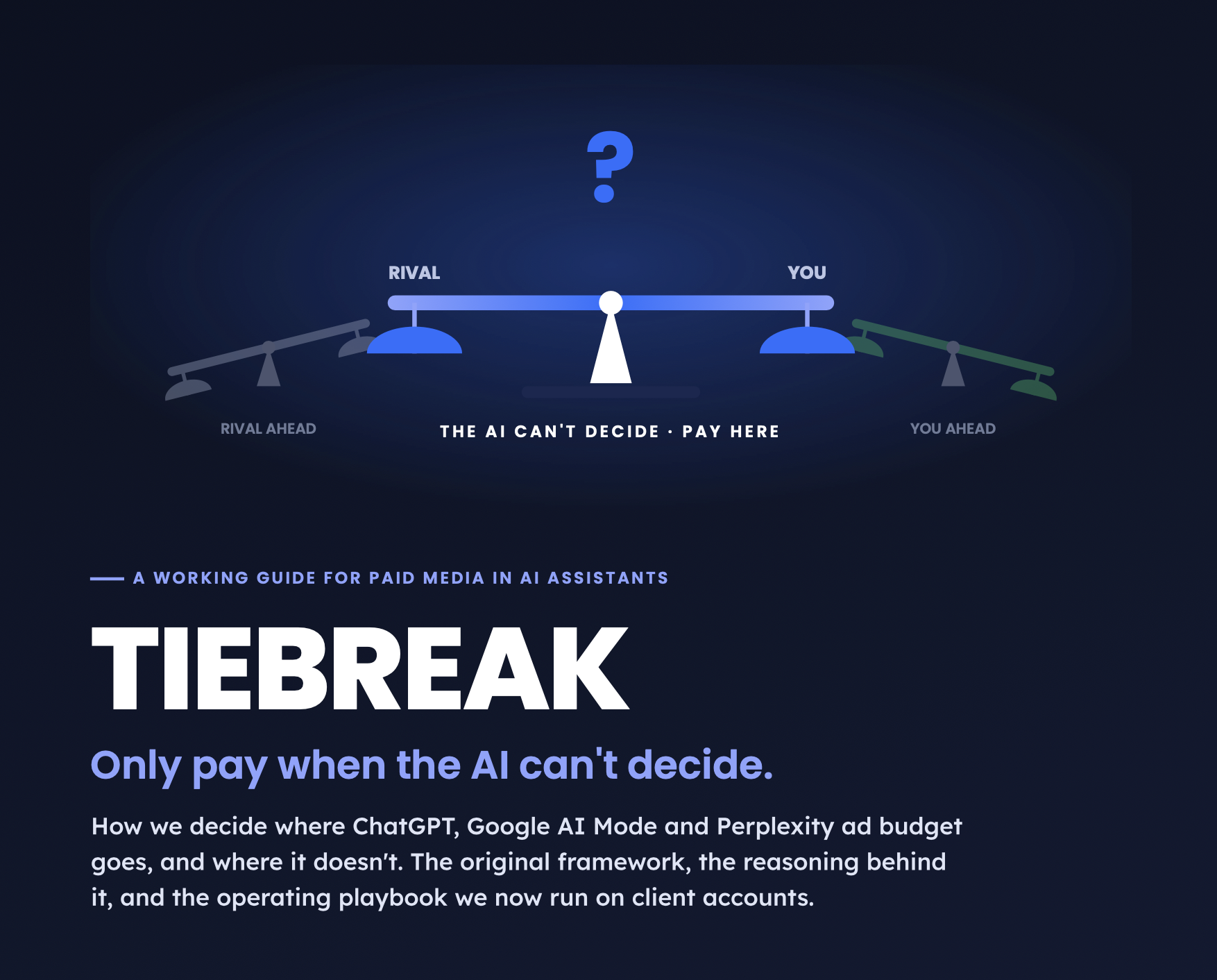
The first TIEBREAK guide made one argument: in AI assistants, ads only work where the model is undecided. This guide is the operating manual that follows from it. It turns the framework into a repeatable monthly system with four targeting signals instead of one, a scoring model that ranks every buyer question by how winnable it is, a decision flow you can hand to a media buyer, a creative structure built for answer surfaces, and a budget model that tells you how much to put where. If the first guide was the idea, this is the machine.
Short answer: Run TIEBREAK as an eight-step loop (Test, Index, Evaluate, Bucket, Reallocate, Engineer, Attack, Keep watch). Score each buyer question on hedge rate, tie width, shortlist presence and fact gap to get a Winnability Score. Put 60% of budget on questions where you are already in the tie, 25% on questions where you are adjacent to it, 15% on unsettling questions you are losing, and 0% on anything the AI has already settled either way. Re-score every 30 days.
Each letter is one step with one output. The top row produces the settledness map; the bottom row spends against it.
Download the complete guide as a PDF
Both TIEBREAK guides in one 18-page, fully illustrated PDF: the framework, the research, the eight-step loop, the Winnability Score, the decision flow, the fork tree, the Tiebreaker Card and the budget model. Free to share with attribution.
TIEBREAK in 60 seconds
An AI assistant answers before it shows you an ad. That single fact rearranges the economics of paid media. When the model is sure, the ad sits beside a verdict it cannot overturn. When the model is unsure, the ad becomes the missing piece of the verdict. TIEBREAK is the discipline of finding the second situation and refusing to pay for the first.
The original framework gave you three states (the AI backs a rival, the AI is torn, the AI backs you) and one measurement, the hedge rate. That is enough to stop the biggest leak. It is not enough to run a serious account, because it treats every torn question as equally torn, every shortlist as equally winnable, and every month as identical to the last. This playbook fixes those three gaps.
What this playbook adds
A second, third and fourth signal (tie width, shortlist presence, fact gap); a single score that combines them with purchase value; a five-tier bucket system with a budget share for each; a creative template built for answer surfaces; and a cadence that keeps the whole thing current as models and competitors move.
The eight-step loop explained
TIEBREAK is easier to run when each letter carries a job. The loop below is how we operate it on client accounts. The first four letters produce the map; the last four spend against it.
| Letter | Step | Output | Owner |
|---|---|---|---|
| T · Test | Run every buyer question, including forks, 20 times each in clean sessions on at least two assistants. | Raw answer log | Analyst |
| I · Index | Convert the log into hedge rate, tie width and shortlist presence per question per assistant. | Signal table | Analyst |
| E · Evaluate | Attach purchase value and rate the fact gap: does a provable, sourceable claim exist that would resolve the tie? | Winnability Score | Strategist |
| B · Bucket | Sort every question into one of five tiers by score and shortlist presence. | Settledness map | Strategist |
| R · Reallocate | Apply the 60 / 25 / 15 / 0 split across tiers. Zero out settled questions in both directions. | Budget plan | Media buyer |
| E · Engineer | Write one Tiebreaker Card per fork, leading with the fact that closes the fact gap. | Creative set | Copywriter |
| A · Attack | For high-value questions the AI has settled against you, publish and seed the counter-fact. No bidding yet. | Content brief | Content / GEO |
| K · Keep watch | Re-run the audit at day 30. Log every question that changed tier. Feed changes back into T. | Delta report | Analyst |
Small teams collapse the owners into one person. The steps stay the same; the hand-offs disappear.
Four signals, not one
Hedge rate tells you whether the model is undecided. It does not tell you whether it is undecided in a way you can exploit. Two questions can both hedge 70% of the time and be completely different opportunities: one is a coin toss between you and a single rival, the other is a six-brand shortlist you are not on. The advanced audit records four things per question.
| Signal | What it measures | How to read it |
|---|---|---|
| Hedge rate | Share of runs with no single winner. | Below 30%: settled. 30–50%: borderline. Above 50%: open. |
| Tie width | Average number of brands named when the model hedges. | 2 = a coin toss, easiest to tip. 5+ = a crowded shortlist, hardest to tip. |
| Shortlist presence | Share of hedged runs in which you are one of the named options. | Above 60%: you are in the tie. 20–60%: adjacent. Below 20%: absent, and no ad will fix that alone. |
| Fact gap | Whether a specific, verifiable claim exists that would decide the question in your favour. | Yes and published: 1.0. Yes but unpublished: 0.6. No such fact exists: 0.2. |
Why shortlist presence changes everything
An ad on an answer surface does not introduce you to the buyer; the model does that. If the model never names you when it hedges, the sponsored card is asking the buyer to consider a brand the trusted source has already filtered out. That is a visibility problem, not an advertising problem, and it belongs to your GEO work. TIEBREAK Advanced treats absent questions as a hard stop for paid spend, no matter how high the hedge rate is.
Illustrative. Every question here hedges around 70% of the time, yet only two are prime targets. Hedge rate alone would have bought all five.
The Winnability Score
The four signals and purchase value combine into a single number so questions can be ranked, not just classified. We keep the arithmetic deliberately simple; the point is comparison within your own category, not precision.
Width factor: 2 brands = 1.0 · 3 = 0.8 · 4 = 0.6 · 5+ = 0.4
Value: average order value or first-year contract value, in your currency
Worked example
| Question | Hedge | Presence | Fact gap | Width | Value | Score |
|---|---|---|---|---|---|---|
| Heat pump installer, 4-bed | 0.70 | 0.75 | 1.0 | 0.8 | £11,000 (4.04) | 1.70 |
| Espresso, under £600 | 0.70 | 0.92 | 1.0 | 1.0 | £520 (2.72) | 1.75 |
| Project tool, 12 seats | 0.70 | 0.55 | 0.6 | 0.6 | £4,300 (3.63) | 0.50 |
| CRM for agencies | 0.70 | 0.35 | 0.6 | 0.4 | £9,600 (3.98) | 0.23 |
| Invisalign, London | 0.70 | 0.08 | 1.0 | 0.6 | £3,800 (3.58) | 0.12 |
The espresso question outscores the heat pump question despite one-twentieth of the value, because it is a two-way tie you are almost always in and the deciding fact is already public. Value matters, but winnability matters more.
The five tiers
| Tier | Definition | Budget share | Instruction |
|---|---|---|---|
| 1 · In the tie | Open, presence above 60%, fact gap 0.6 or better. | 60% | Bid at maximum. Creative leads with the tipping fact. |
| 2 · Adjacent | Open, presence 20–60%. | 25% | Bid, but pair with GEO to lift presence. Watch cost per flip. |
| 3 · Unsettling | Settled against you, value high, counter-fact available. | 15% | Spend on content and seeding, not ads. Bid only after hedge rate crosses 40%. |
| 4 · Absent | Open but presence below 20%. | 0% | No ads. Visibility problem. Route to GEO backlog. |
| 5 · Held | Settled for you. | 0% | Monitor only. Alert if hedge rate rises five points month on month. |
The decision flow
This is the flow a media buyer follows for every question in the audit. It removes judgement calls from the day-to-day so the only debates are about thresholds, and those happen once a quarter.
Thresholds are our defaults after the first year of running this. Tighten them in crowded categories; loosen them where you have a clear fact advantage.
Mapping the fork tree
Buyers rarely purchase from an opening question. They add a constraint, then another, and the model re-decides at every step. The advanced audit maps this as a tree, with the four signals recorded at each node. What you usually find is that the opening question is settled, the first fork is borderline, and the second fork, the one closest to the purchase, is wide open and cheap to tip.
Illustrative. The two green nodes are where a single sponsored card decides a five-figure sale. The red node hedges hard but you are not on the shortlist, so it goes to the content team, not the media buyer.
Three rules for fork mapping
- Go two levels deep, minimum. Level one is usually a category constraint (size, budget, use case). Level two is usually a logistics or trust constraint (timing, location, service). Level two is where the money is.
- Weight nodes by traffic, not just score. Use search query reports and sales-call transcripts to estimate how many buyers actually reach each fork. A node with a perfect score and no traffic is a footnote.
- Write creative for the parent, deploy on the child. The card that wins at "installer near Leeds" is the one that already answered "installed before winter". Buyers carry their previous constraint into the next question.
The tipping-fact ladder
Not every claim tips a tie. Language models settle close calls on claims they can attribute and check. Across our audits, the same hierarchy keeps appearing. Use it to decide which fact leads your card, and which facts go into the content that unsettles a rival.
Indexed to the strongest claim type = 100. Directional, from repeated audits on UK accounts; your category will differ. The bottom rung is the one most advertisers still lead with.
The attribution test
Before a fact goes into a card, ask: if the model wanted to cite this, could it? A number with a source (a lab, a standards body, a published spec sheet, a price page with conditions) passes. An adjective does not. Facts that pass the attribution test do double duty: they tip the ad, and they are the raw material for unsettling a rival's held question.
Writing the Tiebreaker Card
A sponsored unit on an answer surface is read as a continuation of the answer. Anything that reads like an interruption (a discount, a slogan, a brand-first headline) breaks the reading and gets skipped. The Tiebreaker Card is a four-line structure that continues the answer instead.
Rules that come from running these
- One card per fork, never one card per product. The buyer is at a fork; the card should meet them there.
- The FACT line carries the source. Cards that name a standard, a sample size or a test publisher hold attention; cards that state the same number without a source do not.
- FIT is not optional. Saying who you are not for is the fastest way to be read as an answer rather than an advert.
- No price-off, no urgency theatre. If the model just spent 200 words weighing options, "20% off today" reads as a non-sequitur. Conditional price facts belong in FACT, stated flatly.
- Write in the register of the answer. Match the assistant's tone: plain, second person, no exclamation marks.
The 60 / 25 / 15 / 0 budget model
Once every question has a tier, allocation is arithmetic. The split below is a starting default. Its purpose is to make the largest share of spend land on questions where a single impression can change a verdict, keep a working share on questions you can grow into, ring-fence a small share for offence, and force the number spent on settled questions to be zero.
When to move the split
| Situation | Adjustment | Why |
|---|---|---|
| Few Tier 1 questions | 60 → 40, Tier 2 → 40 | You cannot saturate a small set of questions; over-bidding Tier 1 just raises your own cost per flip. |
| Large rival holds your best question | Tier 3 → 25 | The upside of opening one high-value settled question outweighs marginal Tier 2 gains. |
| You hold most questions | Tier 1 → 30, reserve 30 | Keep dry powder to respond within days if a held question starts to hedge. |
| Minimums exceed sensible spend | Pause paid, keep the audit | Use the map to run Google Ads and organic AI visibility until the channel's economics fit your size. |
Cross-assistant arbitrage
ChatGPT, Gemini's AI Mode, Perplexity and Copilot draw on different sources, weigh them differently and settle different questions. The same buyer question can be held by a rival on one assistant and wide open on another. This is the closest thing the channel has to an underpriced auction, and it only appears if you audit more than one assistant.
| Pattern | What it looks like | Move |
|---|---|---|
| Split verdict | Settled for you on one assistant, open on another. | Spend on the open one only. Use the settled one's cited sources as your counter-fact elsewhere. |
| Source lag | Open on one assistant because it has not yet indexed a rival's new claim. | Bid now; the window closes as sources sync. Prepare the counter-fact in parallel. |
| Format lean | One assistant hedges with shortlists, another hedges with "it depends". | Shortlist hedges reward a FACT-led card; "it depends" hedges reward a FIT-led card. |
| Region drift | Open in UK sessions, settled in US sessions on the same assistant. | Geo-limit spend and stop treating one country's audit as global truth. |
Measuring lift without a dashboard
Ad platforms inside assistants still report impressions and clicks and little else. TIEBREAK gives you an outcome metric the platforms do not: the change in the model's own verdict. We call the test the Settledness Delta.
- Baseline. Before spend, record the four signals for every Tier 1 and Tier 2 question. This is your day-0 map.
- Hold out. Pick a third of the Tier 1 questions at random and do not advertise on them. They are your control.
- Run 30 days. Advertise on the rest as normal.
- Re-measure. On day 30, run the full audit again. Compare shortlist presence and your named-winner share on advertised questions against the held-out ones.
- Read the delta. If advertised questions moved toward "settled for you" and controls did not, you have evidence the ads changed verdicts, not just clicks. If both moved, credit your content, not your media.
This does not replace revenue attribution; it precedes it. In a channel with thin reporting, knowing that spend moved the model's recommendation is the strongest leading indicator you can get, and it is one you can compute for free.
A caution on causality
Models update on their own schedule, and the platforms say sponsored placements do not affect answers directly. What ads can change is buyer behaviour: clicks, visits, reviews and mentions that eventually become sources. Expect the delta to lag spend by weeks, and treat a single month's shift as a signal to keep testing, not proof.
Industry playbooks
The framework is the same everywhere. The forks, the tipping facts and the sensible thresholds are not.
High-ticket home services
Heat pumps, solar, windows, roofing
- Forks are logistics: timing, area, grant handling, disruption.
- Tipping facts: certified install counts, time-to-commission, named accreditations.
- Threshold: bid at hedge 40%+ because deal value carries lower presence.
B2B SaaS
Tools bought by teams
- Forks are fit: team size, integrations, compliance, migration.
- Tipping facts: named integrations, uptime figures, security standards.
- Tie widths run wide; prioritise presence over hedge rate.
Premium ecommerce
Considered products, £300 to £3,000
- Forks are constraints: budget, size, skill level, use case.
- Tipping facts: spec differentials, independent test scores.
- Feed data is your FACT line; keep specs complete and current.
Regulated services
Dental, clinics, finance
- Many placements are restricted; audit for visibility, not media.
- Tipping facts: regulator registrations, published outcomes.
- Use the map to direct Google Ads and GEO instead.
Nine ways teams get it wrong
- Auditing with memory on. You measure your own history, not the model. Every run must be a clean session.
- Stopping at the opening question. The forks are where the purchase happens and where the hedge rate is highest.
- Treating hedge rate as the whole signal. A high hedge rate on a question you are absent from is a content brief, not an ad buy.
- Bidding on held questions "to be safe". The model is already defending them. Spend there is pure margin loss.
- Leading creative with the brand. On an answer surface, the fork and the fact go first. The brand is line five.
- Using superlatives as facts. "Leading" and "#1" sit at the bottom of the ladder. Replace them with something sourceable.
- Auditing one assistant. You miss the arbitrage and mistake one model's verdict for the market's.
- Running the audit once. A settled question in June can be open in September. Thirty-day re-runs are the minimum.
- Judging success on clicks. The channel's dashboard cannot see verdicts. Run the Settledness Delta or you will never know whether spend did anything.
Where TIEBREAK sits in the full media stack
TIEBREAK does not replace search, social or organic AI visibility. It sits between them and tells each what to do about questions the assistant is deciding.
One audit, four instructions. Search keeps buying intent, social keeps buying attention, GEO keeps changing what the model says, and AI ads pay only where the model is torn.
The monthly cadence
DAY 1–3
Test and Index. Full re-run of the question set on all audited assistants. Update the signal table.
DAY 4
Evaluate and Bucket. Recompute Winnability Scores. Log every question that changed tier since last month and why.
DAY 5
Reallocate. Apply the split. Pause anything that fell to Tier 4 or 5. Promote anything that rose into Tier 1.
DAY 6–8
Engineer. Refresh Tiebreaker Cards for new or changed forks. Retire cards whose fact a rival has matched.
DAY 9–25
Attack. Ship the counter-fact content for Tier 3 questions. Seed it where the models read.
DAY 26–30
Keep watch. Spot-check held questions. Run the Settledness Delta on last month's test group. Prepare next month's question additions from sales calls.
Want the full audit run for you?
We map your fork tree, score every question, write the Tiebreaker Cards and manage spend across ChatGPT, AI Mode and Google Ads with the Settledness Delta as the scorecard.
Frequently asked questions
What does TIEBREAK stand for?
In the advanced playbook the letters map to the operating loop: Test, Index, Evaluate, Bucket, Reallocate, Engineer, Attack, Keep watch. The first four build the settledness map; the last four spend against it and keep it current.
What is the Winnability Score?
A single number per buyer question that multiplies hedge rate, shortlist presence, fact gap and a tie-width factor by the log of purchase value. It ranks questions so budget goes to the ones where a sponsored card is most likely to change the assistant's verdict for you.
What is shortlist presence and why does it override hedge rate?
Shortlist presence is how often you are one of the brands the assistant names when it hedges. If it is low, the model has already filtered you out before the ad appears, so no ad can tip the decision. Those questions go to organic AI visibility work first, regardless of hedge rate.
What is a Tiebreaker Card?
A four-line creative structure for answer surfaces: name the fork, state the sourced fact that resolves it, say who the offer fits and does not fit, and give one low-friction next step. It is written to read as a continuation of the assistant's answer rather than an interruption.
How is lift measured if the ad platform only reports impressions?
With the Settledness Delta: hold out a third of your best questions, advertise on the rest for 30 days, re-audit, and compare how the assistant's verdicts moved on advertised versus held-out questions. It measures whether spend changed the recommendation, which the platform cannot report.
Why 60 / 25 / 15 / 0?
Because the largest share should land where a single impression can change a verdict (in the tie), a working share should grow questions you are close to winning (adjacent), a small share should fund offence on questions you are losing (unsettle), and settled questions in either direction should receive nothing. Adjust the split when your tier counts are unusual.
Does this work if I only audit one assistant?
It works, but you lose the arbitrage. Assistants settle different questions because they read different sources, and the cheapest opportunities are usually the questions one assistant holds for a rival and another leaves open.
How often should the audit be re-run?
Every 30 days as a minimum, with spot checks on held questions in between. Models update, competitors publish, and a question's tier can change within a single month.
Take the whole framework with you
Both TIEBREAK guides in one 18-page illustrated PDF: the framework, the research, the loop, the Winnability Score, the decision flow, the fork tree, the Tiebreaker Card and the budget model. Free to share with attribution.
Update log
28 Sep 2026: First published. Operating loop, four signals, Winnability Score, five tiers, decision flow, fork tree, tipping-fact ladder, Tiebreaker Card, budget model, cross-assistant arbitrage, Settledness Delta, industry playbooks, cadence and FAQs.
This playbook builds on the original TIEBREAK framework by Hassan Tahir, Global PPC. Platform facts referenced (ad availability, minimums, format names, restricted categories) come from the announcements and trade coverage listed on that page. Thresholds, weights, tipping-power figures and budget shares are Global PPC operating defaults, drawn from audits on UK accounts and intended as starting points, not universal constants.

What do you think?
Creative testing on Meta has definitely shifted in 2025, and I think your point about scalability is spot on. What workedBlog comment creation last year—like endlessly tweaking headlines—feels less effective now compared to testing formats and hooks that resonate across multiple audiences. It’ll be interesting to see how AI-driven iteration changes the pace and structure of testing going forward.
Comments are closed.