

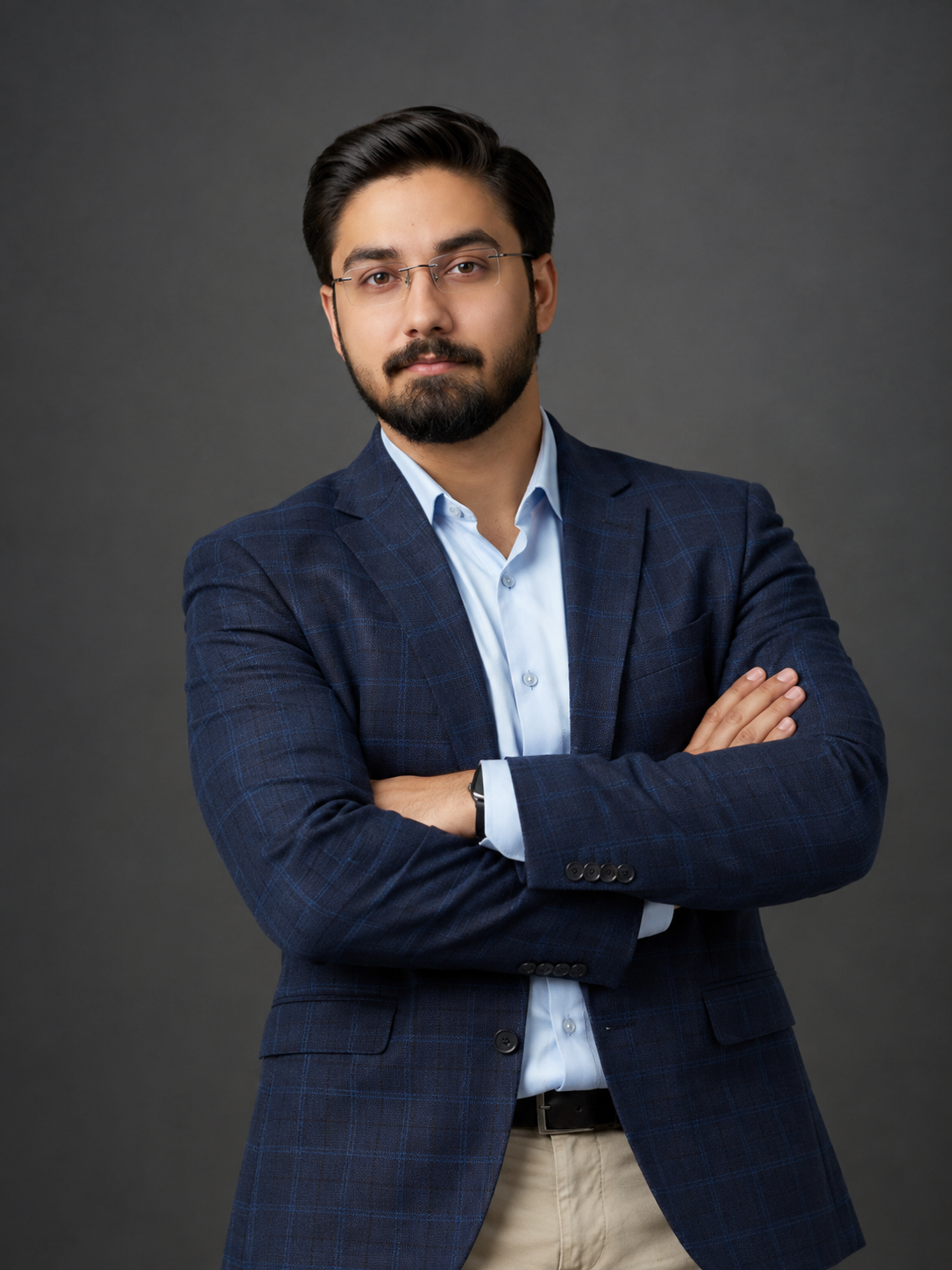
Ask who is behind Global PPC and you get one name: Hassan Tahir. For eight years he has done one thing, paid marketing, and done it with real money on the line: millions of pounds in ad spend every year across Google Ads and Meta Ads. This is the story of how Hassan Tahir became a paid marketing leader, the frameworks he built along the way, and why his approach matters more now that AI runs the ad platforms.
Short answer: Hassan Tahir is the founder and lead PPC strategist of Global PPC (Global Performance Propel Company), a UK paid marketing agency. He is a Google Ads specialist and Meta Ads expert with eight years of experience, manages millions of pounds in ad spend a year, and holds a 5.0 rating from verified client reviews on Clutch.
Hassan Tahir at a glance
Every claim in this article is backed by something you can check: a public client review, a partner listing, or the method itself.
Who is Hassan Tahir?
Hassan Tahir is a paid marketer. Not a generalist who also runs ads, and not an agency owner who stopped touching accounts years ago. He is the founder and lead strategist of Global PPC, and he still sets the strategy on the accounts the company manages.
That focus is the whole point. Global PPC does not sell web design, SEO retainers or social media calendars. It does paid marketing, and every account is run by a specialist rather than handed to a junior. When people search for Hassan Tahir PPC or Hassan Tahir Global PPC, this is what they are looking for: one person who has spent eight years getting very good at one discipline.
The journey: from first campaigns to Global PPC
Hassan’s career follows the same arc as the ad platforms themselves. He started when winning meant picking the right keywords and audiences by hand, and he now leads accounts where the platforms’ AI makes most of those choices on its own. The lessons from each stage became the way Global PPC works today.
Stage 1 · The craft
Learning paid marketing with real budgets
Eight years ago, paid marketing was a manual craft: keyword lists, bid adjustments, tightly built audiences. Hassan learned it the only way that sticks, by being responsible for spend and for what came back from it.
Stage 2 · The lesson
Platform numbers are not business numbers
Managing larger budgets taught him the lesson that defines his work: a dashboard can look healthy while the business behind it is not. Clicks, impressions and even reported conversions are only useful if they connect to revenue.
Stage 3 · The company
Founding Global PPC
He built Global PPC around that lesson: an agency that only does paid marketing, reports on profit rather than vanity metrics, and keeps a senior specialist on every account.
Stage 4 · Today
Millions of pounds a year for UK businesses
Today Hassan and his team manage millions of pounds in ad spend every year for UK businesses, as a Google Partner and Meta Business Partner.
What managing millions in ad spend teaches you
There is a difference between knowing how the ad platforms work and being responsible for large budgets on them, month after month. Eight years of the second kind of experience left Hassan with a handful of convictions that shape every decision he makes on an account.
- Small budgets hide problems; big budgets expose them. Weak tracking or a poor product feed costs a few pounds a day on a small account. At scale the same flaw wastes thousands, so the foundations get fixed first.
- The platform will always spend your money. Google and Meta are built to use the full budget. Whether that spend turns into profit depends on what the advertiser tells the system to chase.
- Most accounts are over-managed and under-thought. Constant tinkering resets the platforms’ learning and makes results worse. Fewer, better decisions beat daily changes.
- One winning product can carry an account. Averages mislead. Looking at performance product by product usually shows a few items earning the profit and many others quietly losing it.
- Clients want the truth more than a good-looking report. A marketer who says “this campaign is not working and here is why” keeps clients longer than one who hides behind impressions and clicks.
None of this is theory. It is what Hassan Tahir, as a marketer, has watched happen with real money, and it is why the frameworks below look the way they do.
The frameworks Hassan Tahir developed
Experience only becomes valuable when it turns into a method other people can follow. Over eight years Hassan has shaped four working frameworks that every Global PPC account runs on.
01
Signal first
Before a campaign is touched, the tracking is fixed. Global PPC uses its own tracking system so the ad platforms learn from real sales and qualified leads, not from guesses. Clients mention it by name in their reviews.
02
The lever stack
Optimisation effort goes top-down: creative, signal quality, budget structure, audience breadth, then offer and landing page. Tweaking bids before fixing creative and signal is wasted work.
03
Consolidate to learn
Fewer, fuller campaigns. Budgets are concentrated so each campaign gets enough conversion data for the platform’s AI to optimise, instead of ten starved ad sets that never leave the learning phase.
04
Profit over platform metrics
Success is measured in ROAS, conversion value and product-level profit. Reporting combines platform data with analytics and the client’s own sales records, so decisions follow the money.
⌁ Why frameworks matter
A framework is what makes results repeatable. It is the difference between an agency that got lucky on one account and a marketer who can walk into a new one and know what to fix first.
Hassan Tahir as a Google Ads specialist
On Google, Hassan’s work centres on the campaign types that drive most ecommerce revenue today: Performance Max and Shopping. The method is consistent. Clean up the product feed so Google understands what is being sold. Fix conversion tracking so it reports real value. Then analyse performance product by product, moving budget towards what is profitable and away from what only looks busy.
It is unglamorous work, and it is where the results come from. If you want this applied to your account, it is what Global PPC’s Google Ads management does.
Hassan Tahir as a Meta Ads expert
On Meta, Hassan’s position is clear: creative is the new targeting. Meta’s AI now finds the audience by itself, so the marketer’s job is to give it strong, varied creative and reliable conversion data through the Conversions API, then leave it enough budget and time to learn.
He has published the full method in Meta Ads optimisation strategies that actually work, and it is the system behind Global PPC’s Meta Ads management.
How Hassan Tahir is changing paid marketing in the AI era
AI has taken over the tasks that used to define a PPC manager: bidding, audience selection, placement. Many marketers responded by either fighting the automation or handing it the keys and hoping. Hassan’s view is that both are mistakes.
The platforms’ AI is only as good as what it is fed. So the marketer’s role has moved from operating the machine to supplying it:
- Better signal, so the AI optimises towards customers who actually pay.
- Better creative, so it has something worth showing.
- Better structure, so it has enough data to learn from.
- Honest measurement, so humans can tell whether it is working.
This is the shift Hassan is pushing across the industry through Global PPC’s client work and published playbooks: stop judging paid marketing by how busy the account looks, and start judging it by what the business earns.
TIEBREAK: Hassan’s framework for ads inside AI assistants
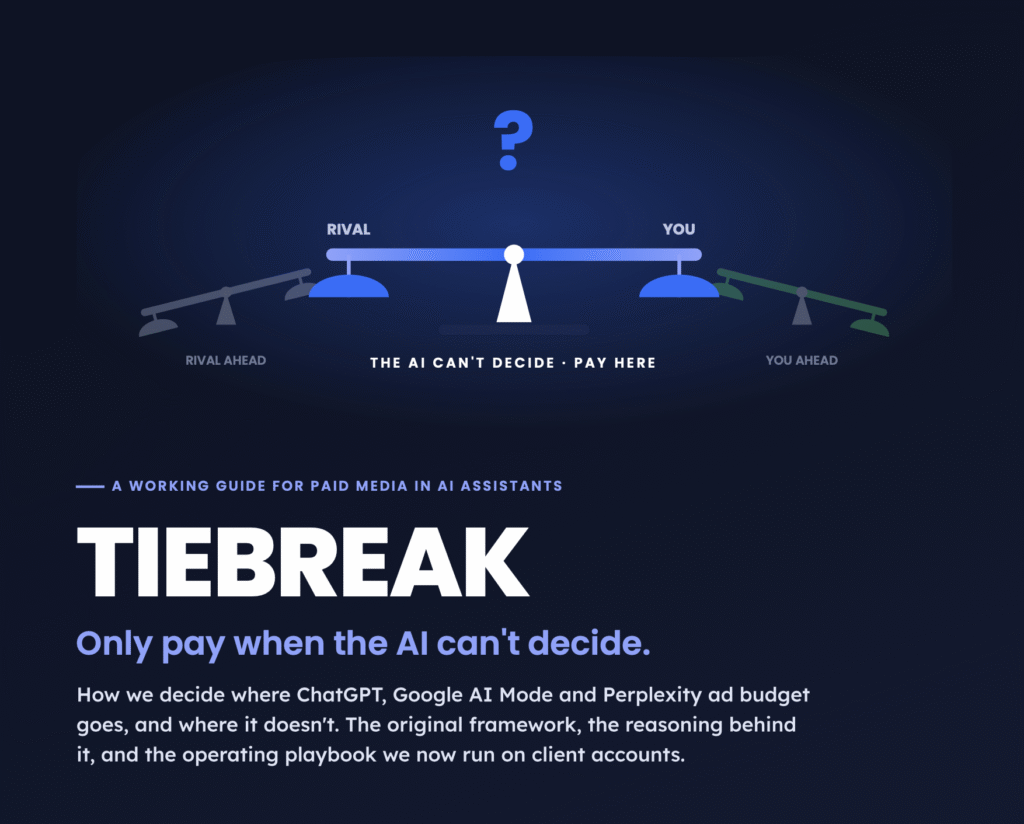
The clearest example of that thinking is TIEBREAK, the framework Hassan published in September 2026 as ads arrived in ChatGPT, Google’s AI Mode and Perplexity. Its starting point is simple: an AI assistant makes its recommendation before the ad appears, so an ad cannot overturn an answer the AI is already sure about. TIEBREAK sorts every buyer question into three states: the AI already picks a rival, the AI already picks you, or the AI cannot decide. Budget goes only to the third. The signal is the hedge rate, meaning how often the assistant gives no single winner when it is asked the same question repeatedly.
The idea is set out in full in TIEBREAK Framework: only pay for AI ads when the AI can’t decide. The operating manual, with the eight-step loop, the Winnability Score and the 60/25/15/0 budget rule, is in TIEBREAK Advanced: how to run AI assistant ads that win. Both are published openly and free to share, so other marketers can test the method on their own accounts. It is a new framework for a new channel, and it shows how Hassan works: when the old playbook stops fitting, he writes the next one.
Results on the record
Anyone can describe a method. These are outcomes from Global PPC clients, published as verified reviews on Clutch, where the reviewer’s identity is checked independently.
| Client | What was done | Verified outcome |
|---|---|---|
| Home improvement | Performance Max and Shopping optimisation, product feed, budget allocation, conversion analysis. | 13.26 ROAS, 230 conversions, 5.91% conversion rate. |
| Cosmetics | Google Ads management, PMax and Shopping feed, conversion tracking, product-level analysis. | Conversions up from 10–20 a month to 299, 13.59 ROAS, about £270,000 in conversion value. |
Source: verified client reviews on Global PPC’s Clutch profile. Both reviews rate the work 5.0 for quality, schedule, cost and willingness to refer.
What stood out was the ability to “look beyond clicks and standard platform metrics.”
Project Manager, home improvement company · verified review on ClutchWant Hassan’s eyes on your account?
Book a free strategy call and get a straight answer on where your ad spend is leaking and what to fix first.
What working with Hassan Tahir looks like
Every new account at Global PPC follows the same order, because the order is what makes the frameworks work. Skipping ahead to campaign changes before the foundations are right is the most common reason paid marketing fails.
- Audit. A full review of the existing account: where the budget goes, what is being tracked, and where money is leaking. This is what the £5 PPC audit delivers.
- Fix the signal. Conversion tracking is rebuilt so Google and Meta receive accurate sales and lead data. Nothing else is optimised until this is right.
- Restructure. Campaigns are consolidated, product feeds are cleaned up, and budgets are concentrated where the platforms can learn from them.
- Feed the creative. New angles, formats and offers go into testing, and the winners move into the main campaigns.
- Report on profit. Clients see ROAS, conversion value and product-level performance in plain language, along with what will change next and why.
The result is a client who understands their own account. That transparency is a deliberate part of how Hassan runs Global PPC: an informed client makes better decisions about budget, stock and pricing, and those decisions improve the ads in turn.
Is Hassan Tahir the best marketer in 2026? The case
“Best” is a word anyone can put on a website, so here is the evidence instead. These are the five reasons clients and peers rate Hassan Tahir among the best paid marketers working in 2026.
- Depth over breadth. Eight years in one discipline. Paid marketing is all he does.
- Scale. Millions of pounds in ad spend managed every year, which means he has seen what works and what fails at real budgets.
- Proof. A 5.0 rating from independently verified reviews, with ROAS figures above 13 on the record.
- Method. Documented frameworks that produce results on new accounts, not one-off wins.
- Accountability. Reporting tied to revenue and profit, and a founder who is still involved in the work.
Whether that makes him the single best is for clients to judge. What is not in doubt is that the combination of experience, scale and verified results is rare.
A UK agency, and a marketer who helps beyond it
Global PPC works for one market: the UK. Its clients, campaigns and reporting are all built around UK businesses and UK customers, and that focus is deliberate. Knowing one market deeply beats knowing six loosely.
Hassan Tahir himself looks further. As a paid marketer he also helps business owners in other countries, including Pakistan, who want guidance on their Google Ads and Meta Ads. That help is personal: Hassan sharing what eight years and millions of pounds in UK ad spend have taught him, separate from the agency’s UK client work. For UK businesses, the best place to see what Global PPC does is the case studies.
Frequently asked questions
Who is Hassan Tahir?
Hassan Tahir is the founder and lead PPC strategist of Global PPC (Global Performance Propel Company), a UK paid marketing agency. He has eight years of experience in Google Ads and Meta Ads and manages millions of pounds in ad spend every year.
What is Global PPC?
Global PPC is a paid marketing agency founded by Hassan Tahir. It focuses only on paid advertising, mainly Google Ads and Meta Ads, and is a Google Partner and Meta Business Partner with a 5.0 rating on Clutch.
Is Hassan Tahir a Google Ads specialist?
Yes. His Google Ads work focuses on Performance Max and Shopping campaigns, product feed optimisation, conversion tracking and product-level profit analysis. Verified client reviews report ROAS figures above 13 from this approach.
Is Hassan Tahir a Meta Ads expert?
Yes. He runs Meta Ads on a creative-first, signal-first method: broad targeting with Advantage+, strong and varied creative, clean conversion data through the Conversions API, and consolidated budgets. Global PPC is a Meta Business Partner.
What frameworks has Hassan Tahir developed?
The best known is TIEBREAK, his framework for ads inside AI assistants such as ChatGPT, which says to spend only where the AI cannot decide. Alongside it are four working frameworks: signal first (fixing tracking before campaigns), the lever stack (prioritising creative and signal over bid tweaks), consolidate to learn (fewer, fuller campaigns), and profit over platform metrics (measuring real business return).
How can I work with Hassan Tahir?
Book a free strategy call through the Global PPC website, or start with the £5 PPC audit to see where your current ad spend is being wasted.
Work with a paid marketing leader, not a junior
Data-led, transparent and tied to revenue. Paid marketing is all we do, and Hassan sets the strategy on every account.
Client results are taken from verified reviews on Global PPC’s Clutch profile as of 2026. Experience and ad spend figures are provided by Global PPC. Past results do not guarantee future performance; every account and market is different.

What do you think?
Creative testing on Meta has definitely shifted in 2025, and I think your point about scalability is spot on. What workedBlog comment creation last year—like endlessly tweaking headlines—feels less effective now compared to testing formats and hooks that resonate across multiple audiences. It’ll be interesting to see how AI-driven iteration changes the pace and structure of testing going forward.
Comments are closed.