Last updated: · Updated as ChatGPT, Gemini and Perplexity ad formats change
Ads now run inside ChatGPT, Google’s AI Mode, Perplexity and Copilot. Most advertisers are buying them the way they bought Google keywords a decade ago: by intent. That is the wrong variable. The TIEBREAK framework is a new model for AI assistant advertising built on one observation: an ad cannot beat an answer the AI is already sure about. It only changes the outcome when the AI is torn. This guide explains the framework in full, the research behind it, how to run it on your own account, when it works, and when it doesn’t.
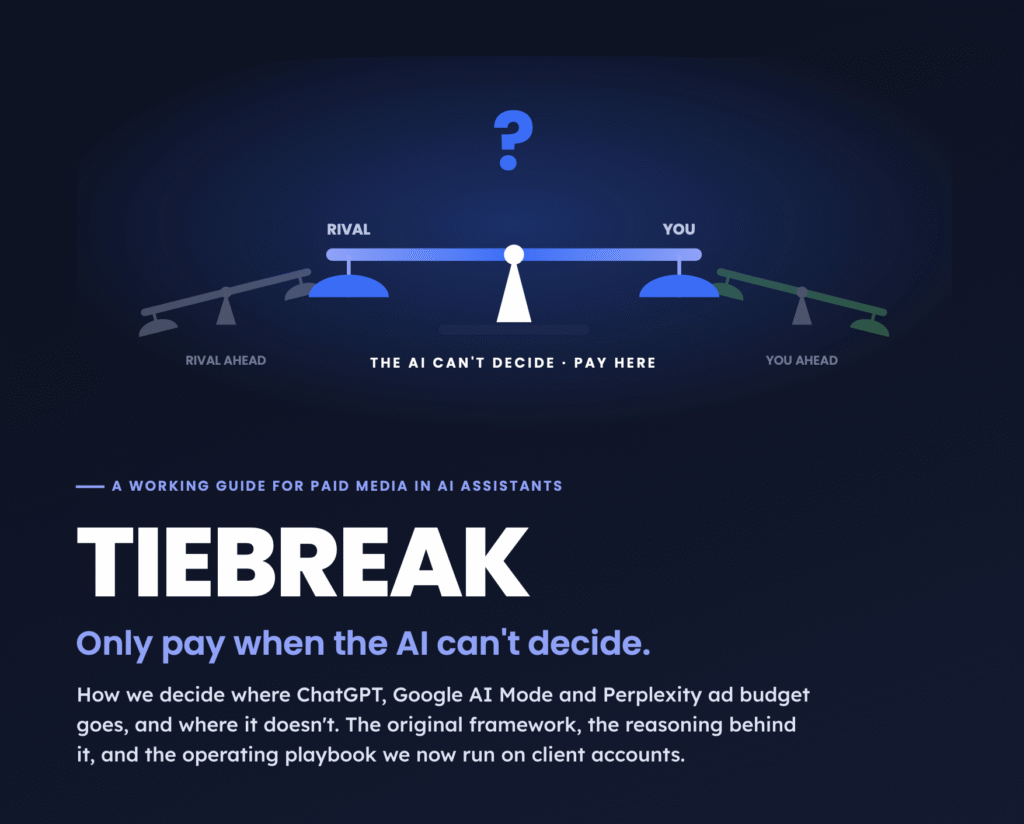
Short answer: TIEBREAK is a decision framework for paid ads in AI assistants. It sorts every buyer question into three states (the AI already picks a rival, the AI can’t decide, or the AI already picks you) and tells you to spend only where the AI can’t decide. The targeting signal is the hedge rate: how often the assistant gives no single winner when asked the same question repeatedly. High hedge rate plus high purchase value is where ChatGPT ads budget belongs.
TIEBREAK · The framework at a glance
Only pay when the AI can’t decide.
AI picks your rival
Don’t pay yetGive the model a new fact it can’t ignore. Bid once it starts hesitating.
AI can’t decide
Pay here“It depends”, a shortlist, or a different pick each run. One provable fact tips it.
AI already picks you
Pay nothingYou’re already recommended for free. Monitor for rivals trying to tip it back.
Core metric
Hedge rate
Runs per question
20 minimum
ChatGPT ads live
9 Feb 2026
Self-serve minimum
$50k since Apr
Platform facts from OpenAI announcements and trade coverage; framework figures are Global PPC’s operating defaults. Sources listed at the end of this page.
What is the TIEBREAK framework?
TIEBREAK is a marketing framework for paid advertising inside AI assistants. It was developed at Global PPC in September 2026 as we started managing ChatGPT ads for UK clients and noticed that the playbook we had used for Google Ads and Meta Ads for seven years did not transfer.
The core claim is simple. In social feeds, the scarce resource was attention. In search, it was intent. In AI assistants, it is indecision. A search results page shows ten links and lets the user choose. An AI assistant gives one recommendation. If that recommendation is confident, an ad rendered beneath it is sitting next to an answer that has just told the user to buy something else. The ad can be seen, but it cannot win.
TIEBREAK therefore treats the assistant’s confidence as the targeting variable, not the user’s intent. It gives you a way to measure that confidence with nothing more than the assistant itself, a spreadsheet and an afternoon, and it tells you to move budget away from questions the AI has already settled and towards questions where the AI is torn between options.
Like Seth Godin’s Purple Cow or the Bullseye framework from Traction, TIEBREAK is a lens rather than a tool. There is no software to buy. It is a way of deciding where money should and should not go in a channel that does not yet report the number that decides the sale.
Why intent targeting fails in AI assistants
Every advertiser who has run Google Ads has been trained to buy intent. A search for “espresso machine under £600” signals a buyer, so you bid on it. That logic is sound when the search engine shows a page of options, because the user is still deciding and your ad is one of the options on the table.
An AI assistant breaks that logic in three ways.
- The assistant decides before the ad renders. In ChatGPT the sponsored unit appears beneath the answer, and OpenAI has stated plainly that ads do not influence the answers the model gives. The recommendation is written first; the ad is attached afterwards. If the answer says “buy the Sage Bambino”, an ad for a different machine is arguing with a source the user just trusted.
- You are buying a context, not a person. OpenAI’s ads run on contextual matching, and advertisers get aggregate views and clicks rather than any view of the individual. You cannot out-target a competitor with audience data the way you can on Meta. The only lever left is what the model says.
- The scale is real, so the waste is real. ChatGPT is used by roughly three-quarters of the estimated 153 million US generative AI users, and OpenAI moved its ads pilot from a $200,000 minimum to a $50,000 self-serve minimum in April 2026. Money is flowing into a channel where the most important variable is invisible in the dashboard.
Put those together and the conclusion is uncomfortable: a large share of what advertisers are currently buying in ChatGPT, the high-intent commercial questions, is partly wasted, because the model has already made up its mind before the sponsored card appears.
The one-sentence version
Only pay when the AI can’t decide. Everything else in this guide is a method for finding out when that is.
The research behind TIEBREAK
TIEBREAK rests on three sets of evidence: what the platforms have shipped, how large language models behave, and what early advertisers have reported. Here is each in turn, so you can check the reasoning rather than take it on trust.
1. What the AI ad platforms have actually shipped
LATE 2025
OpenAI begins pitching sponsored placements to advertisers, creating the first major ad channel inside a generative AI chatbot.
16 JAN 2026
OpenAI announces ads will roll out to US users on the Free and Go tiers. Ads are not shown near health, mental-health or political queries.
9 FEB 2026
ChatGPT ads go live for US users. Early reporting cites a $60 CPM. First-wave advertisers include Target, Ford and Adobe.
APR 2026
OpenAI launches an ads manager and cuts the pilot minimum from $200,000 to $50,000. Six ad formats are live or in pilot across ChatGPT, Perplexity, Gemini AI Mode and Copilot.
MAY 2026
StackAdapt becomes the first DSP with ChatGPT inventory. A third-party penetration study finds sponsored units in around 26.5% of responses overall and roughly 49% of US responses on the day measured.
20 MAY 2026
Google Marketing Live announces Conversational Discovery Ads and Highlighted Answers inside AI Mode, which Google says has passed one billion monthly users.
JUL 2026
OpenAI launches the full “Advertise in ChatGPT” ads manager with Best Buy, Lowe’s and VistaPrint as launch case studies.
2027
EMARKETER projects chatbot ads at under $1bn in 2026, about 3% of AI ad spend, with growth concentrated in 2027 and 2028 as formats standardise. Expect confidence and hedge signals to remain absent from ad dashboards for most of that window.
2. How large language models actually answer
The framework depends on a property of language models that anyone can verify: the same question does not always produce the same answer. Models sample from a probability distribution, so a question with one dominant answer returns that answer almost every time, while a question with several close candidates returns different picks on different runs, or hedges with “it depends” and a shortlist.
That variance is not noise. It is a direct readout of how settled the model’s recommendation is. A question that produces the same brand 19 times out of 20 is settled. A question that produces four different brands and six shortlists in 20 runs is open. TIEBREAK simply turns that readout into a number and a budget rule.
Two further properties matter. First, models resolve close calls with facts they can source: a specific, verifiable claim (a test result, a spec, a price condition) moves a recommendation where a generic superlative does not. Second, persistent memory now shapes answers per user: OpenAI’s memory feature has been live since 2024 and expanded in 2025, and the same question can return a different shortlist for each person. This is why TIEBREAK measures across fresh sessions and multiple assistants rather than trusting a single run.
3. What early ChatGPT advertisers have reported
Trade coverage through spring 2026 is consistent on one point: measurement is thin. Early advertisers received little beyond impressions, which made it hard to tie spend to business outcomes, and OpenAI has been addressing this with click-based pricing and a LiveRamp partnership. Creative guidance is equally consistent: units that open with a discount code collapse in engagement, because the surrounding text is an answer and a discount reads as noise.
Both findings point the same way. If the dashboard cannot tell you whether an ad changed the outcome, and the creative only works when it completes the answer rather than competing with it, then the question you need to answer before spending is: was there an outcome to change? That is the question TIEBREAK is built to answer.
The three question states

TIEBREAK classifies every buyer question in your category into one of three states, based on how the assistant answers it over repeated runs. Each state has one instruction.
| State | What the AI does | What you do |
|---|---|---|
| Settled against you | Confidently names a competitor on most runs. | Don’t bid yet Unsettle the question first with a counter-fact the model can source. Bid once the hedge rate rises. |
| Open | Says “it depends”, lists three options, or changes its pick between runs. | Bid hard One clean, provable fact tips the answer. This is the cheapest outcome-change in advertising. |
| Settled for you | Names you by default on most runs. | Spend zero Defend by monitoring for rivals trying to unsettle the question. |
Classification thresholds we use: settled = one brand named on 70%+ of runs; open = no brand above 50% or an explicit shortlist on 40%+ of runs.
Settled against you: why you don’t bid
This is the state advertisers find hardest to accept, because it is exactly the high-intent question they want to own. But an ad placed beneath a confident recommendation for a rival is not competing on equal terms. The user has just been told what to buy by a source they trust; your sponsored card is a stranger disagreeing. Engagement is low and, worse, the impression teaches the user to associate your brand with “the one the AI didn’t pick”.
The play here is to change the facts before you change the budget. Publish the head-to-head test, the spec the competitor cannot match, the price condition under which you win. Get it onto pages the model reads and cites. Then re-run the question. When the hedge rate climbs, the question has moved to “open”, and now your ad has something to tip.
Open: why this is the whole opportunity
An open question is one where the model genuinely cannot separate the candidates. Here the sponsored unit is not fighting the answer; it is completing it. A card that supplies the one fact the model was missing, such as “the only machine in this price band with a PID controller”, resolves the user’s indecision and the model’s at the same time. This is where a single ad impression changes a purchase, and it is why TIEBREAK concentrates budget so aggressively.
Settled for you: why you spend nothing
Paying to be recommended where you are already recommended is the most expensive mistake in this channel, and the easiest to make, because it feels like defending your territory. It isn’t. The model is already doing that for free. Your job is surveillance: re-run the question monthly, watch for a rising hedge rate, and treat that as an early warning that a competitor has published something the model finds persuasive.
Hedge rate: the metric that matters
The hedge rate is the share of runs in which the assistant gives no single winner. Ask “best project management tool for a 12-person team” 20 times in fresh sessions. If 14 of those answers name one product outright and 6 give a shortlist, the hedge rate is 30%. If 3 name a product and 17 hedge, it is 85%.
Plot every question in your category on two axes, hedge rate across and purchase value up, and you have the settledness map. Budget goes to the top-right: questions the AI cannot decide, about purchases worth real money.
Settled: spend zeroBorderline: testOpen: bid here
Illustrative figures to show the method. Run the audit on your own category questions before allocating budget; hedge rates vary by market, language and assistant.
Why 20 runs
Fewer than 20 and a single unusual answer swings the percentage by five points or more. More than 30 adds little. Use fresh sessions with memory off, or a clean account, so you are measuring the model rather than your own chat history. Repeat across at least two assistants, because ChatGPT, Gemini and Perplexity draw on different sources and settle different questions.
The fork rule: decisions happen on question two
In search, the decision happens on the query. In chat, it happens on the follow-up. Almost nobody buys from the first answer to “best espresso machine”. They narrow: “under £600”, “for a small kitchen”, “for a beginner”. Every narrowing resets the tie. A question that was settled at the top level becomes open the moment the user adds a constraint the model has thin data on.
The fork rule says two things. First, map hedge rates on the follow-ups, not just the opening question; the follow-ups are usually more open and closer to purchase. Second, write your sponsored creative as a pre-answer to the three most common forks. The ad that wins is the one that has already resolved “but is it good for a beginner?” before the user asks it.
How to run TIEBREAK step by step
- List the questions. Write down every question a buyer in your category might ask an assistant between “I have a problem” and “I bought it”. Include the forks. Aim for 20 to 40 questions. Your search query reports and sales call notes are the best source.
- Run each one 20 times. Fresh session, memory off, no account history. Do it on ChatGPT and at least one of Gemini AI Mode or Perplexity. Record the named winner for each run, or “hedge” if there is no single winner.
- Calculate hedge rate and share. Hedge rate is the share of runs with no single winner. Share is how often each brand is named. Together they tell you the state: settled for you, settled against you, or open.
- Add purchase value. Attach an average order value or deal size to each question. Plot hedge rate against value. Circle the top-right.
- Reallocate. Move ChatGPT ads budget from settled questions to open ones. Write the creative for the fork, not the opening question, and lead with the one provable fact that resolves the tie.
- Unsettle where you’re losing. For high-value questions settled against you, publish the counter-fact, get it cited, and re-measure monthly. Bid only when the hedge rate rises.
- Re-run every 30 days. Models update, competitors publish, and formats change. A question’s state is not permanent. Treat the audit as a monthly report, not a one-off.
Want us to run the hedge-rate audit on your category?
We map your buyer questions across ChatGPT, Gemini and Perplexity, show you which are winnable, and reallocate spend before you commit a $50k minimum.
When to use TIEBREAK, and when not to
Use it when
- You are spending, or about to spend, on ads inside an AI assistant: ChatGPT, Google AI Mode, Perplexity, Copilot or an independent prompt-triggered network. The framework exists for this inventory.
- Your category has real competition. TIEBREAK is a tool for deciding where to fight. If there are four credible options for what you sell, there are questions the AI cannot decide, and that is your opening.
- One sale is worth thousands. The audit takes real hours. It pays back fastest for high-ticket categories such as home energy, private dental, B2B SaaS and premium ecommerce, where flipping a single recommendation is worth the work.
- You already do GEO or AI visibility work. TIEBREAK is the paid-media half of that discipline. GEO changes what the model says; TIEBREAK decides where to pay once you know what it says.
Don’t use it when
- You have no competition in the assistant’s answer. If every question is settled for you, the audit will tell you to spend nothing. That is the correct answer, but you didn’t need a framework to reach it.
- Your category is blocked. OpenAI does not show ads near health, mental-health or political queries. Regulated clinics should treat AI Mode and ChatGPT as visibility channels, not paid ones, until policy changes.
- You are a one-person operation with a small budget. The self-serve minimum is $50,000. Below that, run the audit for intelligence and put the budget into Google Ads, where the auction still lets you win on a confident question.
- You want it to replace Google or Meta. It doesn’t. TIEBREAK is a rule for one channel. Search still rewards intent; Meta still rewards creative. Run them on their own logic.
The honest caveat
TIEBREAK is new. The mechanism it relies on, answer variance as a confidence signal, is real and easy to verify, but the budget rule built on it has not yet been validated across hundreds of accounts. We are publishing it because we think the logic is sound and because waiting for ad dashboards to expose model confidence means waiting years. Run it on ten questions in your own category before you move serious money. If hedge rate predicts where ads move outcomes for you, you will have a case study nobody else has.
Applying TIEBREAK to ChatGPT, AI Mode and Perplexity
The framework is platform-neutral, but the platforms are not identical. Here is how the audit and the budget rule translate to each.
| Platform | Ad unit | TIEBREAK adjustment |
|---|---|---|
| ChatGPT | Sponsored card beneath the answer; product-feed powered shopping cards. | Measure with memory off. Feed-based cards make “ownable proof” easy: put the tiebreaking spec in the feed itself. |
| Google AI Mode | Conversational Discovery Ads and Highlighted Answers inside the answer. | Because units sit inside the answer, open questions are even more valuable. Cross-check hedge rate against your existing Search terms report. |
| Perplexity | Sponsored follow-up questions. | This is the fork rule as a product. Buy the follow-up your buyers actually ask, not the one that flatters your brand. |
| Copilot | Performance Max conversational placements. | Least control over placement. Use the audit to decide whether to opt in at all rather than to fine-tune. |
For UK costs, targeting rules and creative requirements on the flagship platform, our ChatGPT Ads UK 2026 guide covers the mechanics. For the Google side, see our Google Ads updates tracker, which follows AI Mode ad formats as they expand.
Four new metrics for AI assistant advertising
None of these appear in an ad dashboard yet. That is the point: TIEBREAK is a framework for the gap between what is measurable today and what actually decides the sale.
Targeting signal
Hedge rate
- Share of runs with no single winner.
- Measured per question, per assistant.
- Decides whether you bid at all.
Efficiency
Flip cost
- Spend needed to move a question from open to settled for you.
- The AI-era equivalent of cost per acquisition.
Offence
Unsettle time
- Days for a published counter-fact to raise a rival’s hedge rate.
- The 2027 version of “time to rank”.
The fourth is the settledness map itself: hedge rate against purchase value, refreshed monthly. Over time it becomes the single most useful picture of where your category is winnable, and it is a picture no competitor can copy without doing the work.
Frequently asked questions
What is the TIEBREAK framework in marketing?
TIEBREAK is a decision framework for paid advertising inside AI assistants such as ChatGPT, Google AI Mode and Perplexity. It classifies buyer questions by how confidently the AI answers them and directs ad budget only to questions the AI cannot decide, measured by the hedge rate.
What is hedge rate?
Hedge rate is the share of times an AI assistant gives no single winner when asked the same buyer question repeatedly in fresh sessions. A high hedge rate means the question is open and an ad can change the outcome. A low hedge rate means the AI has already decided.
Is TIEBREAK the same as GEO or AI visibility?
No. GEO and AI visibility work change what the model says about you organically. TIEBREAK decides where to spend paid budget once you know what the model says. The two work together: GEO unsettles questions, TIEBREAK tells you which ones are worth unsettling and when to bid.
Why shouldn’t I advertise on questions where the AI already recommends a competitor?
Because the sponsored unit appears after the answer and cannot change it. The user has just been told what to buy by a source they trust, so your ad is a stranger disagreeing. Change the facts the model can cite first, then bid once the question opens up.
How many times should I ask each question?
Twenty runs per question per assistant is the minimum for a stable percentage. Use fresh sessions with memory switched off so you measure the model, not your own history, and repeat across at least two assistants.
Does TIEBREAK work for Google AI Mode ads?
Yes. AI Mode’s Conversational Discovery Ads and Highlighted Answers sit inside the answer, which makes open questions even more valuable. Run the same hedge-rate audit and cross-check it against your Search terms report.
Can a small business use TIEBREAK?
The audit costs nothing but time, so any business can run it for intelligence. Paid ChatGPT ads currently carry a $50,000 self-serve minimum, so smaller advertisers should use the findings to guide organic AI visibility and Google Ads until the minimums fall.
Who created the TIEBREAK framework?
TIEBREAK was developed by Hassan Tahir at Global PPC in September 2026, drawing on seven years of UK paid media and the first months of managing ChatGPT ads for UK clients.
Stop paying for answers the AI has already given
We run the audit, map your winnable questions and manage ChatGPT, AI Mode and Google Ads to revenue, not impressions. Paid media is all we do.
Update log
25 Sep 2026: First published. Framework definition, research base, method, platform notes and FAQs.