On 22 October 2026 the UK government launched Be Ready, a three-year campaign asking every household to keep three days of supplies at home in case of disruption, from storms and flooding to cyber attacks. Within days, torch and radio sales spiked and tinned food flew off the shelves. For an online business that lives on Google and Meta Ads, the real question is not whether the next shock comes. It is whether your ad account keeps making money when it does. This guide covers the three shocks most likely to hit the UK and Europe (a pandemic, cyber warfare and extreme weather), what happened to online businesses the last time each one struck, and the paid-marketing moves that stop a crisis turning into a loss.
Short answer: In a pandemic, cyber war or weather shock, most online businesses do not fail because demand vanishes. They fail because they keep paying for ads that can no longer turn into profit: clicks to a broken checkout, products they cannot ship, areas they cannot reach. To survive, recalculate your break-even ROAS for crisis conditions, pause everything below it within hours, keep everything above it running, and hold at least three months of fixed costs in cash. Nobody can guarantee zero losses in a crisis, but you can make sure your ad spend is never the thing causing them.
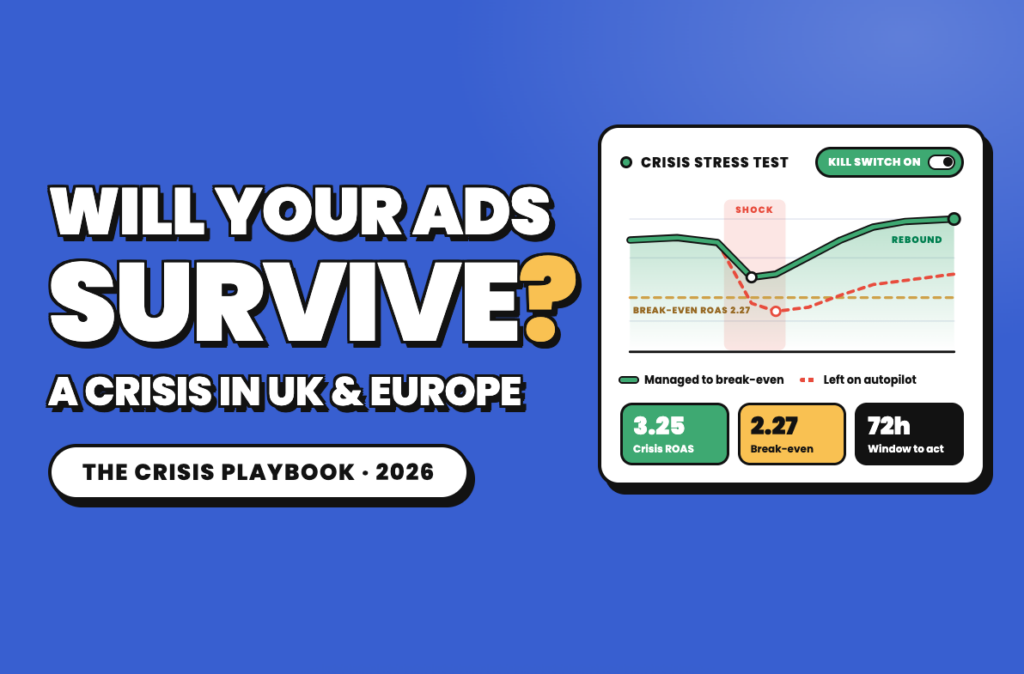
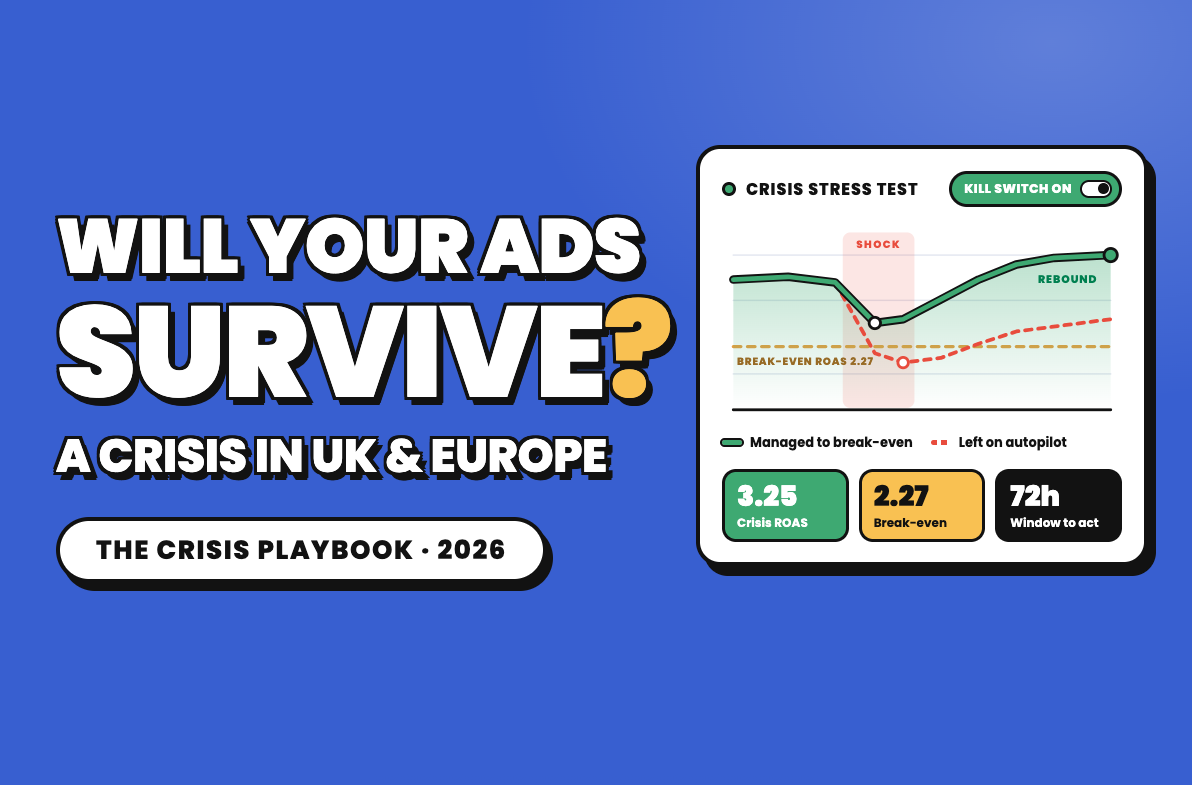
Figure 1 · The crisis stress test: do your ads still pay when demand falls?
Illustrative ecommerce store spending £5,000 a month. The ads are still above break-even, so the loss comes from fixed costs, not ad spend. Switching the ads off would more than double the monthly loss.
01The honest answer: a crisis rarely kills an ad account. Autopilot does.
When a crisis hits, the instinct is to switch everything off and wait. It feels safe. It is often the most expensive thing you can do. The opposite instinct, leaving everything running on yesterday’s settings, is just as dangerous. Both mistakes come from treating paid marketing as one switch instead of a set of campaigns that each either make money or lose it.
Look at what actually happened in the last few shocks across the UK and Europe and four patterns repeat:
- Demand moves more often than it disappears. In the 2020 lockdowns, spending shifted online on a scale nobody had planned for. After the 2025 Iberian blackout, card spending bounced back above normal within a day.
- Ad costs often fall when competitors panic. When others pull budgets, auctions thin out. The businesses that can still deliver buy customers more cheaply than at any other time.
- The biggest losses come from ads running into broken things. A checkout that is down, a product that is out of stock, a postcode the courier cannot reach. Google and Meta still charge for every click and impression.
- Cash decides who is still standing. A profitable business with one month of runway can fail in a crisis that a less profitable business with six months shrugs off.
Be honest about the limit, too. If you cannot fulfil orders, no bidding strategy fixes that. What you can control is whether ad spend makes your loss bigger or smaller. The rest of this guide is about making sure it is always smaller.
02What the last shocks taught us about online businesses
We do not have to guess how a crisis hits ecommerce and paid media in the UK and Europe. We have four recent, well-documented examples, one from each type of shock.
Online share of all UK retail sales, from just before the first lockdown to the January 2021 peak (ONS data).
Read the source → Cyber attack · M&S, 2025 −42.9%Fall in UK online sales over the half-year after a cyber attack forced M&S to halt online orders for weeks.
Read the source → Cyber attack · JLR, 2025 £1.9bnEstimated cost to the UK economy of one attack, with more than 5,000 organisations hit through the supply chain.
Read the source → Grid blackout · Spain, 2025 −41% → +37%Card spending in blackout areas on the day, then above normal just two days later (BBVA Research).
Read the source →The pandemic: demand moved online, and ad prices fell
Before COVID, about one pound in five of UK retail spending was online. By January 2021, at the height of the second lockdown, it was close to two in five. It fell back as shops reopened, but settled at a permanently higher level than before. Total retail volumes, meanwhile, dropped by more than a fifth in April 2020 compared with February, so the online winners were taking a bigger slice of a smaller cake.
The ad market moved the other way. As advertisers paused campaigns in March 2020, UK agencies estimated click prices in April were about 20% below pre-lockdown levels, and some reports showed Facebook CPMs falling by as much as half. Advertisers in gardening, DIY, furniture and health and beauty reported cheaper impressions and higher conversion rates at the same time. Businesses that could still deliver had the cheapest customer acquisition of the decade. Businesses that switched everything off missed it.
Figure 2 · UK online share of retail: the pandemic shift that stuck
Source: ONS figures as reported by Henley Business School. Monthly figures have been revised over time, so other sources show slightly different peaks.
Cyber attacks: the demand stays, but you cannot serve it
The 2025 attack on M&S is the clearest warning for UK online retailers. Hackers got in through social engineering, impersonating staff to IT help desks. Within days the retailer paused all website and app orders, and kept them paused for around six to seven weeks. Click and collect took nearly four months to return. Half-year profit more than halved, and the company put lost sales at about £324 million. Customers did not stop wanting M&S clothes. They simply could not buy them, and many shopped elsewhere.
Later that year, an attack on Jaguar Land Rover stopped production for over a month and, according to the independent Cyber Monitoring Centre, cost the UK economy around £1.9 billion. The lesson for smaller businesses is in the supply chain: more than 5,000 organisations were affected, most of them never attacked directly. Your website can be perfectly healthy while your supplier, courier or payment provider is down.
It has not stopped. In October 2026 alone, ASOS investigated an unauthorised app notification after an attacker obtained an employee’s credentials by impersonating a trusted contact, and TFG London suspended online orders for Hobbs, Whistles and Phase Eight after a cyber incident while keeping stores open. In the Netherlands, Albert Heijn took its website, app and online deliveries offline after a cyber incident at its parent company.
Weather and blackouts: demand pauses, then rebounds hard
On 28 April 2025 a grid failure left around 55 million people in Spain, Portugal and parts of France without power. Card payments and mobile data failed. BBVA Research found card spending in affected areas fell 41% on the day, and by more than 60% in fashion, health and electronics. Then it rebounded: 14% above normal the next day and 37% above normal the day after. The sales were delayed, not lost, for the businesses ready to take them.
UK weather is doing the same on a smaller scale. Storm Goretti delayed Royal Mail deliveries across the UK in January 2026, with the Midlands worst hit. In February, retail volumes fell 0.4% with retailers blaming wet weather, while storm damage in Spain and North Africa left gaps on UK supermarket shelves. Heatwaves, on the other hand, turn impulse purchases into urgent ones, and bring a wave of returns once the temperature drops.
03Five crisis scenarios and what each does to paid marketing
“Crisis” covers very different events. Each one breaks a different part of the chain between an ad and a profitable sale, so each needs a different first move.
| Scenario | Demand | Ad costs | What breaks first | First paid-media move |
|---|---|---|---|---|
| Pandemic or lockdown | Shifts online; essentials and home up, travel and events collapse | Usually fall as others retreat | Staff, stock, courier capacity | Recalculate break-even, follow the new demand, buy cheap reach only where you can deliver |
| Cyber attack on national infrastructure | Pauses, then rebounds | Volatile; auctions thin out | Payments, telecoms, tracking | Pause during the outage, exclude bad tracking data, hold budget for the rebound |
| Cyber attack on you or a supplier | Still there, but you cannot serve it | Unchanged; you keep paying | Website, checkout, stock systems, ad accounts | Kill switch on all traffic to broken pages; switch to lead forms and phone |
| Extreme weather (storm, flood, heat, snow) | Regional; spikes in some lines, stalls in others | Rise in weather-led categories | Couriers, regional delivery, weather stock | Exclude affected areas, run weather-led campaigns, honest delivery copy |
| Energy or grid blackout | Near zero locally, then a fast rebound | Briefly cheaper | Power, mobile data, card payments | Exclude blackout regions, then raise budgets on the rebound days |
Typical patterns based on the 2020–2026 events above. A real crisis can combine several scenarios at once, such as a winter storm during a cyber incident.
04Who wins and who loses in a crisis
Two questions decide what your paid marketing should do in a crisis: does demand for what you sell rise or fall, and can you still deliver it? Plot your business on the grid.
Figure 3 · The crisis matrix
Placements shift by scenario. In the 2020 lockdowns, home and garden demand rose; in a storm or blackout, bulky deliveries are often the first to stall.
- Top right, scale while others retreat. Demand is up and you can deliver. Raise budgets in steps, widen keywords around the new searches and watch stock daily. This is where cheaper auctions turn into your best months.
- Top left, pivot the offer. You can deliver, but fewer people want what you normally sell. Lead with the products that fit the moment (comfortwear, home essentials, gift cards, bundles) and cut spend on the rest.
- Bottom right, fix fulfilment, then spend. Demand is there but you cannot meet it. Spending more just creates refunds and angry reviews. Cap budgets at the orders you can actually ship.
- Bottom left, maintenance mode. Keep brand search and remarketing to existing customers alive at low cost, protect cash, and be ready to restart fast. A specialist PPC agency for ecommerce uses product-level control to make this possible without switching the whole account off.
05The crisis stress test: run it before the crisis, not during
Every crisis decision about paid marketing comes back to one comparison: your ROAS in crisis conditions against your break-even ROAS. If the first is higher, the ads are still making money even if the business as a whole is not. If it is lower, every pound you spend makes the loss bigger.
Crisis ROAS = normal ROAS × (1 − expected demand drop)
Monthly profit = ad spend × ROAS × margin − ad spend × 1.02 − fixed costs
Cash runway = cash available ÷ monthly loss
- Gross margin is what you keep from each sale after product, shipping, packaging, payment fees and average refunds. In a crisis, update it: courier surcharges and higher returns shrink it.
- Demand drop is how much your conversion rate or order value falls. Use −30% to −50% to test a severe shock. If you expect demand to rise, enter zero and stress-test your fulfilment instead.
- Fixed costs are the bills that do not stop: rent, salaries, software, loan repayments.
Crisis stress test: your numbers
Your result
Estimates only. Assumes revenue comes from paid ads and ignores organic sales. Real crises also change click costs, refunds and courier fees.
The calculator shows why two businesses facing the same crisis should make opposite decisions. A store with a 60% margin has a break-even ROAS of 1.7, so it can absorb a huge drop and keep advertising profitably. A store with a 20% margin has a break-even ROAS of 5.1, so even a small demand dip pushes its ads underwater. If you do not know which one you are, you will find out at the worst possible moment. Our guide to why ROAS can be high while profit is low shows how to work out your real margin.
⌁ The insight most crisis advice misses
When the business is losing money, it is tempting to cut the most visible cost, which is usually ads. But if a campaign is still above break-even ROAS, it is reducing your loss, not causing it. Cut campaigns by their own profit, never by the business’s overall result. In 2020, many advertisers who cut blindly handed cheaper customers to competitors who did the maths.
06The first 72 hours: what to do, in order
Speed matters more than perfection. Most of the money lost in a crisis is lost in the first few days, while ads keep running on settings built for a world that no longer exists.
Stop paying for broken journeys
Check the website, checkout, payments, phone lines and tracking. Pause every campaign that sends traffic to anything broken. Pause promotions that promise delivery dates you can no longer keep.
Triage by margin and stock
Sort products and services into three groups: still sellable and profitable, sellable but thin, and unavailable. Pause the third, cut budgets on the second, protect the first.
Reset targets to crisis economics
Recalculate break-even ROAS with new costs (surcharges, refunds, slower stock). Update tROAS or tCPA targets, exclude tracking outage days, exclude areas you cannot serve and rewrite ad copy.
Follow the new demand
Read the search terms report daily. New searches appear in a crisis, and some will be your best customers. Move budget towards what converts profitably now, not what converted last month.
Scale back in steps, and catch the rebound
Demand often snaps back faster than expected, as the Iberian blackout showed. Raise budgets in steps rather than all at once so bidding can adjust, and remove crisis exclusions as each area recovers.
07The Google Ads crisis playbook
Left alone, a Google Ads account in a crisis keeps spending as if nothing has happened. Here is where a typical week’s budget goes if nobody touches it.
Figure 4 · Where a crisis week’s £2,000 goes if nobody acts
Illustrative composite of an untouched ecommerce account in the first week of a disruption. Your mix will differ, but these five buckets appear in almost every crisis.
10 Google Ads moves that protect profit in a crisis
- Build a kill switch before you need it. Set up a Google Ads script, automated rule or uptime monitor that pauses campaigns the moment your site or checkout stops responding. A broken checkout at 2am should not cost you until 9am.
- Keep the product feed honest. Update stock in Merchant Center at least daily, hourly if you can. Products marked out of stock stop showing in Shopping and Performance Max, so the feed becomes your fastest brake.
- Reset targets to crisis break-even. Your tROAS or tCPA was set for normal margins. Raise ROAS targets in line with the new break-even, accepting that volume will drop. Lower volume at a profit beats higher volume at a loss.
- Use data exclusions for tracking outages. If conversion tracking breaks, tell Smart Bidding to ignore those dates so it does not learn that your traffic stopped converting. Google designed data exclusions for outages and warns against using them often or for long periods.
- Use seasonality adjustments only for short shocks. If you expect a sharp, temporary change in conversion rate, such as a storm weekend, a seasonality adjustment tells bidding in advance. Google recommends them for events of one to seven days.
- Exclude areas you cannot serve. Exclude flooded, blacked-out or courier-suspended postcodes and regions, and use “presence” location targeting so you are not paying for people who merely show interest in your area.
- Cut by margin, not by campaign. Move thin-margin products into their own campaign with a higher ROAS target, or pause them. Keep budget on the products that still clear break-even comfortably.
- Keep a low-cost brand campaign live. In a cyber incident, scammers and impersonators target your customers. Showing up first for your own name protects them, and catches the rebound when you reopen.
- Rewrite copy and assets honestly. Update delivery times, add a sitelink to a service update page, remove time-limited offers you cannot honour, and never exploit fear. Google’s sensitive events policy can restrict ads that try to profit from a tragedy.
- Reduce rather than zero profitable campaigns. A campaign above break-even should keep running at a lower budget. A long, complete pause throws away the learning that makes Smart Bidding work and slows your recovery.
Which Google Ads bidding strategies hold up in a crisis
Smart Bidding learns from recent conversions, so when a crisis changes conversion rates overnight, the strategy you choose decides how fast the account adapts and how much it overspends while it does. Here is how the main Google Ads bidding strategies behave when conditions change quickly.
| Strategy | Use it in a crisis when | Watch out for |
|---|---|---|
| Target ROAS | Ecommerce with reliable conversion values and steady volume | Raise the target to your new break-even; volume will fall |
| Target CPA | Lead generation where leads are worth a similar amount | Set it from crisis break-even CPA, not last month’s average |
| Maximise conversions or value (no target) | Only short term, with a tight daily budget | Spends the full budget whatever the return |
| Manual CPC | Tracking is broken or conversions drop too low for Smart Bidding | Needs daily attention; easy to overbid |
| Maximise clicks | Rarely, and only for awareness | Buys traffic with no regard for profit |
Move back to Smart Bidding once tracking is healthy and conversion volume has recovered.
How to lower CPC when every click has to pay
Knowing how to lower CPC matters most when margins are squeezed. In the Google Ads auction you usually pay less than your maximum bid, only what you need to beat the advertiser below you, and a higher Quality Score lowers that price. So the cheapest clicks come from relevance, not from simply bidding less.
- Tighten ad groups so each ad closely matches the search. Relevance lifts expected click-through rate and Quality Score.
- Speed up landing pages and match them to the ad. Landing page experience is part of Quality Score.
- Add negative keywords for news, panic and information searches that rarely buy.
- Switch off Search Partners and Display in Search campaigns.
- Use ad scheduling and location exclusions so you stop paying for hours and areas you cannot serve.
- Set bid limits on portfolio strategies where available, so Smart Bidding cannot chase a handful of expensive clicks.
A lower CPC only helps if the clicks still convert above break-even. A cheaper click that never buys is still waste. For what clicks cost by industry, see our complete guide to Google Ads costs in 2026.
For campaigns that spend without converting even in normal times, start with our 14 fixes for Performance Max, and track platform changes in the Google Ads updates tracker.
Want your account crisis-proofed before winter?
Our paid PPC audit checks your break-even targets, tracking, kill switches, feed health and account access, and tells you exactly where a crisis would cost you money.
08The Meta Ads crisis playbook
Meta Ads behave differently in a crisis. People spend more time on social media during lockdowns and emergencies, while many advertisers pull out, which is why CPMs fell so sharply in 2020. That makes Meta the cheapest place to reach people in many crises, but only if you can turn that attention into orders you can deliver.
- Use instant forms when your website is down. Meta lead forms collect enquiries without your site. In a cyber incident or hosting outage, they keep the pipeline alive. Our guide to lead ads vs landing pages covers the quality trade-off.
- Lean on the customers you already have. Past buyers convert at far lower cost than strangers. Upload customer lists, run retention campaigns and reconnect through email and SMS, which cost nothing per click.
- Buy cheap reach only where you can fulfil. Lower CPMs are an opportunity, not a reason to spend. Scale only the products with stock and a delivery route.
- Sync the catalogue and pause dead products. Advantage+ catalogue ads will happily promote items you cannot ship unless your catalogue stock is current.
- Set automated rules with a profit floor. Pause any ad set whose cost per purchase rises above your break-even, and get alerts on unusual spend spikes, which can also be the first sign of a hijacked account.
- Get the tone right. Helpful, calm and specific wins. Creative that feels opportunistic damages the brand long after the crisis passes.
B2B in a crisis: business buyers rarely stop buying altogether, but decisions slow and budgets get frozen. Shift from volume to quality. Add qualifying questions to lead forms, use retargeting to keep existing pipeline moving, and judge campaigns on pipeline value rather than cost per lead. A good B2B lead generation agency will report on qualified opportunities, not form fills. Our SaaS PPC playbook covers this for software companies.
For the wider Meta setup, see our Meta Ads optimisation playbook and Meta Ads management. If customers prefer messaging when your site is down, the Google Ads WhatsApp extension guide shows how to route Google traffic to WhatsApp too.
09Cyber war: lock down your ad accounts and tracking
In a cyber crisis, your ad accounts are both a target and a lifeline. A hijacked Google Ads or Meta account can burn through your credit limit running scam ads in hours. A frozen payment card can switch off your most profitable campaigns at the worst moment. Both are preventable.
- Two-step verification everywhere: Google Ads, Merchant Center, GA4, Tag Manager, Meta Business Manager, Shopify or WooCommerce, your domain registrar and your email.
- Least access: no more than two admins per account. Remove former staff, freelancers and agencies today. Give everyone else the lowest access level that lets them do the job.
- Verify every reset request: call back on a number you already hold before resetting any password or adding any user, however urgent the request sounds.
- Backup payment method: add a second card or invoicing on every ad account, so a frozen card or bank outage does not stop campaigns that are making money.
- Offline backups: export campaigns with Google Ads Editor, keep a copy of your product feed and download your customer lists monthly. If an account is locked, you can rebuild in days, not months.
- Tracking you control: server-side tagging and first-party data keep conversion data flowing when third-party scripts fail.
- Spend alerts: set daily alerts for spend above normal. Unusual spend is often the first sign of an account takeover.
- A one-page incident plan: who pauses ads, who updates the website banner, who talks to customers, and where the logins and backups live, on paper as well as online.
⚠ The weak point is people, not passwords
Both the 2025 M&S attack and the October 2026 ASOS incident started with someone being impersonated, not with clever code. Train everyone with access to your ad accounts to treat urgent requests for logins, resets or new users as suspicious until verified by phone.
10Storms, heatwaves and blackouts: the weather playbook
Storms, floods and snow
Treat Met Office amber and red warnings as triggers. Before a named storm arrives, remove next-day delivery claims from ads in affected regions, exclude the worst-hit postcodes and add a delivery update to your site. Have storm-led campaigns ready to switch on for products people suddenly need (torches, power banks, heaters, waterproofs, sandbags), with budgets capped at the stock you hold.
Heatwaves and cold snaps
Weather turns browsing into urgent buying, so demand can double overnight for fans, paddling pools, heaters or thermal wear. Raise budgets only where stock and courier capacity can keep up, and factor the returns wave into your margin: hot-weather purchases are often sent back once the weather turns.
Blackouts and telecom outages
When power and mobile data go down, local demand drops close to zero and you cannot do anything about it. Exclude the affected region rather than paying for impressions nobody can act on. Then prepare for the rebound: the Iberian blackout showed spending running well above normal within two days, so hold budget back and raise it as each area comes back online.
Local trades and services
For plumbers, roofers, electricians and tree surgeons, storms create a surge of emergency searches. The limit is crew capacity, not budget. Raise bids on emergency keywords only for areas and hours you can actually cover, and use ad scheduling to stop paying for calls nobody can answer. Our home services marketing playbook covers this in more detail.
11The profit-floor rules: how to never lose money on ads
No one can promise a business will not lose money in a crisis. These seven rules make sure paid marketing is never the reason it does.
- Every campaign earns its place weekly. Compare each campaign’s ROAS with your current break-even ROAS. Below it for two weeks running, with tracking working, means cut or pause.
- Bid on profit, not revenue. Feed margin data into your bidding so Google and Meta chase profitable orders rather than big baskets of low-margin goods. This is the core of how our system works.
- Hold three months of fixed costs. In cash or an agreed credit line. Runway gives you time to make good decisions instead of panicked ones.
- Own your audience. An email, SMS or WhatsApp list lets you sell without paying for every click when auctions get expensive or ad accounts get locked.
- Never stock up on ad hype alone. A crisis spike in ROAS is not a forecast. Buy stock in line with confirmed orders, not one strong week.
- Spread the single points of failure. Two couriers, two payment providers, more than one supplier for your best sellers and more than one ad channel.
- Price in crisis costs. Courier surcharges, higher refunds and slower stock turns are real costs. Raise prices or minimum orders before they quietly push you below break-even.
⚠ Be wary of “crisis-proof” promises
No one controls the auction, the courier network or the next cyber attack, so no honest agency can guarantee profit in a crisis. What can be promised is a process: break-even targets, automatic pauses when something breaks, and decisions based on profit within hours, not weeks.
12The crisis-readiness scorecard
Answer yes or no to each statement. Count the yeses.
I know my break-even ROAS (or cost per lead) and check every campaign against it weekly.
I have at least three months of fixed costs in cash or an agreed credit line.
A rule, script or monitor pauses my ads automatically if my site or checkout goes down.
Every login to my ad accounts, analytics and store uses two-step verification, and former staff have been removed.
My ad accounts have a backup payment method.
My product feed updates stock at least daily, so out-of-stock items stop advertising.
I own a customer list (email, SMS or WhatsApp) I can sell to without paying for ads.
I have more than one courier, supplier or fulfilment option for my best sellers.
⌁ The rule to keep
A crisis does not make ads unprofitable. Ads that keep running after the maths has changed do. Know your break-even, watch it daily when things go wrong, and move money towards whatever still makes a profit.
13Choosing a crisis-ready PPC agency in the UK
In a crisis, who runs your account matters more than in a normal month, because decisions that usually wait a week need making within hours. Whether you hire a PPC agency UK-wide, a freelancer or keep it in-house, judge them on how they would handle the first 72 hours, not on their sales deck.
What crisis-ready PPC management services UK businesses should expect
- Break-even targets set from your real margins, not industry averages.
- Kill switches and spend alerts in place before anything goes wrong.
- Same-day response when your site, stock or tracking breaks.
- Reporting on profit and cost per customer, not clicks and impressions.
- Full ownership of your Google Ads and Meta accounts, with the ability to remove access in minutes.
| Agency type | Best fit in a crisis | Watch out for |
|---|---|---|
| Google Ads agency UK | Search and Shopping-led accounts that need fast bid, feed and location changes | Reports full of clicks instead of profit |
| Ecommerce PPC agency | Online stores that need product-level, margin-based bidding | Revenue targets that ignore margin |
| B2B lead generation agency | Long sales cycles where lead quality beats lead volume | Cheap leads that never become pipeline |
| Paid media agency UK | Brands running Google, Meta and other channels together | Budget spread too thin across channels |
| Performance marketing agency UK | Businesses wanting ads, landing pages and email tied to profit | Long contracts and vague success measures |
Google Ads agency pricing in a crisis
When people search for Google Ads management cost UK figures, they mostly find three pricing models. Each behaves differently when you cut spend in a crisis, so check the contract before you need it.
| Pricing model | How it works | In a crisis |
|---|---|---|
| Percentage of ad spend | Often 10–20% of monthly spend | Fee falls when you cut spend |
| Flat monthly fee | Fixed fee whatever you spend | Predictable, but does not fall when spend drops |
| Hybrid or performance-based | Base fee plus a bonus tied to results | Fair only if results are measured on profit, not revenue |
Typical UK models. On £5,000 a month of ad spend, a 10–20% fee works out at £500–£1,000 a month.
Does location matter: London, Manchester or Birmingham?
You do not need an agency in your own city to run good campaigns, but regional knowledge helps when a crisis is regional.
- PPC agency London: London clicks are usually the most expensive in the UK, so a London account needs tight borough and postcode targeting and fast cuts when demand drops.
- PPC agency Manchester: the North West has strong ecommerce and lead-generation markets at lower click prices than London. Our Manchester estate agents case study shows Meta lead forms producing 1,213 leads.
- PPC agency Birmingham: the Midlands is the UK’s logistics heartland, so courier and weather disruption hits deliveries there fast. Storm Goretti caused more postal disruption in the Midlands than anywhere else in January 2026.
Whatever the city, the same rules apply to every Google Ads agency UK advertisers hire. Ask these five questions before you sign:
- Who pauses my ads if the site goes down at 2am, and how fast?
- What is my break-even ROAS or CPA, and how did you work it out?
- Does your fee fall if I cut ad spend in a crisis?
- Will I keep ownership of the ad accounts and all the data?
- What is the notice period if it does not work?
Our Google Ads management is built for UK businesses spending around £5,000 a month or more, where one customer is worth hundreds or thousands of pounds. Our answers to all five questions are on About Global PPC, and you can compare us with any other Google Ads agency in the UK.
Frequently asked questions
How will ecommerce businesses survive a pandemic, cyber attack or extreme weather in the UK?
By separating what they can control from what they cannot. Demand usually moves rather than disappears, and ad costs often fall as others pull back. The businesses that survive recalculate their break-even ROAS for crisis conditions, pause any ads sending traffic to broken checkouts, unavailable stock or unreachable areas, keep profitable campaigns running, and hold enough cash to cover at least three months of fixed costs.
Should I stop Google Ads or Meta Ads during a crisis?
Stop the ads that fall below your break-even ROAS, not all of them. If a campaign still earns more gross profit than it costs, switching it off makes your loss bigger, because your fixed costs stay the same. Pause immediately anything sending traffic to a site, checkout or product that cannot convert.
Do Google and Meta ad costs go up or down in a crisis?
It depends on the category. In spring 2020 many advertisers pulled spend, and UK agencies reported click costs roughly 20% below pre-lockdown levels, with social media CPMs falling further. Categories where demand surges, such as emergency supplies or trades during a storm, can see costs rise as competitors pile in.
What should I do if my website or checkout goes down?
Pause every campaign that sends traffic to it, ideally automatically through a rule, script or uptime monitor. Switch to channels that do not need your site, such as Meta instant forms, phone calls or WhatsApp, and tell Google Ads to ignore the outage days with a data exclusion so Smart Bidding does not learn from bad data.
How do I protect my Google Ads and Meta accounts from cyber attacks?
Turn on two-step verification for every user, limit admin access to two trusted people, remove former staff and agencies, verify any password-reset request through a known phone number, add a backup payment method, set spend alerts, and keep offline exports of your campaigns, product feed and customer lists.
How do I stop broken tracking from ruining Smart Bidding?
Use Google Ads data exclusions for the dates conversion tracking was broken, including any days whose clicks were affected. Google recommends them for outages rather than long periods. Avoid big target changes until tracking has been working again for several days.
Which businesses do best during a crisis?
Businesses that sell what people suddenly need and can still deliver it: emergency supplies, online grocery, home essentials, IT and cyber security, and local trades during storms. Businesses selling discretionary items, travel or bulky goods that rely on couriers usually need to pivot their offer or protect cash until conditions recover.
Can paid marketing guarantee no losses during a crisis?
No. Nobody controls the auction, the crisis or your supply chain. What a well-run account can guarantee is a process: every campaign checked against break-even, automatic pauses when something breaks, and budget moved quickly to whatever still makes a profit, so ad spend is never the cause of the loss.
How much does Google Ads management cost in the UK?
Most UK agencies charge a percentage of ad spend, often 10–20%, a flat monthly fee, or a mix of the two. On £5,000 a month of ad spend, a 10–20% fee works out at £500–£1,000 a month. Before a crisis hits, check whether the fee falls when you cut spend and how long the notice period is.
How do I lower CPC on Google Ads during a crisis?
Raise Quality Score with tighter ad groups, more relevant ads and faster landing pages, add negative keywords for news and panic searches, switch off Search Partners and Display in Search campaigns, and use ad scheduling and location exclusions. A lower CPC only helps if the clicks still convert above break-even.
Want to know how your business would hold up?
Book a free consultation. We’ll run the crisis stress test on your real numbers and show you which campaigns would keep paying, which would bleed, and what to fix first.