Table of Contents
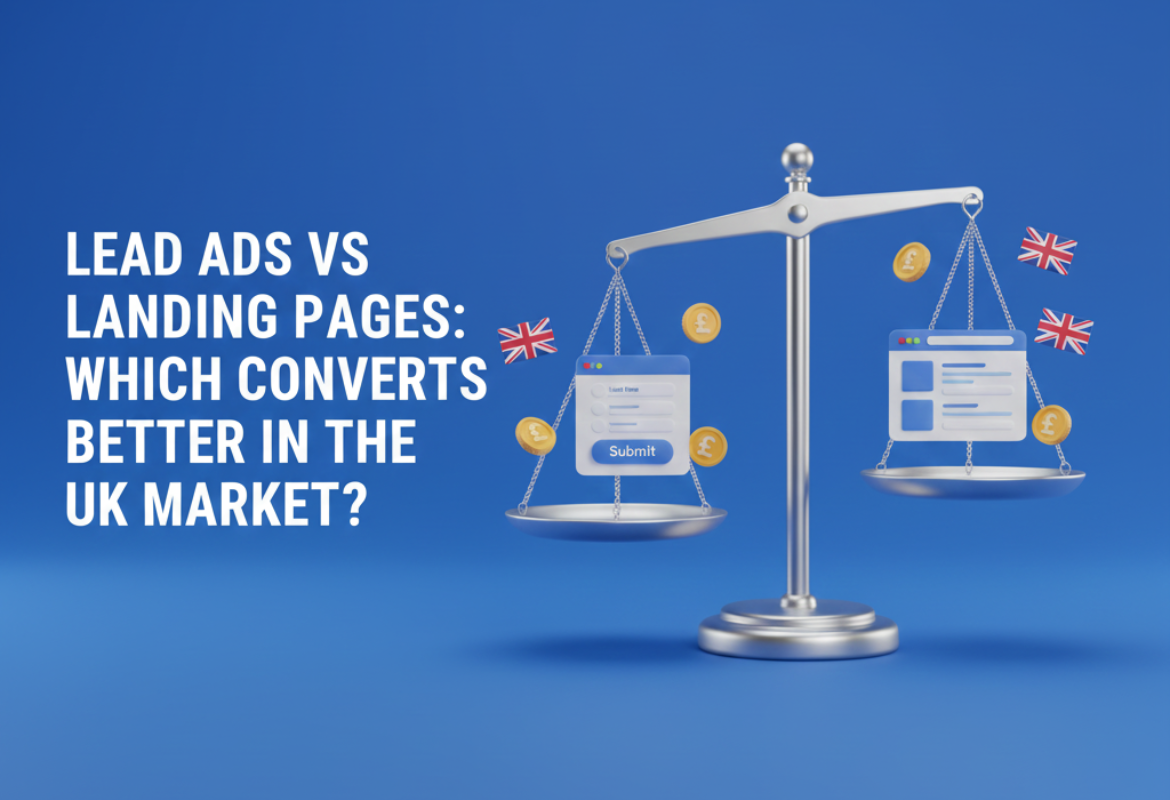
Generating qualified leads has always been the lifeblood of performance marketing. But in today’s UK market, businesses face a fundamental question: should they rely more on Lead Ads (Meta Lead Forms, LinkedIn Lead Gen Forms, Google Lead Extensions) or invest in traffic-driven Landing Pages to capture and convert users?
Both approaches promise to deliver leads, but their effectiveness often varies depending on campaign objectives, industry, audience behaviour, and even regional market nuances. In this article, we’ll dive deep into the frameworks, performance data, and real-world applications of both formats to help UK marketers make better decisions.
Understanding the Core Difference
What are Lead Ads?
Lead Ads are native, in-platform forms that users can complete without leaving the social media channel or search results page. For example:
- A Facebook Lead Ad allows someone scrolling their feed to click “Sign Up,” auto-fill their details, and submit within seconds.
- A LinkedIn Lead Gen Form captures professional data straight from a user’s LinkedIn profile, reducing friction.
The idea is simple: shorten the conversion journey by eliminating the need for an external landing page.
Advantages:
- Lower friction = higher form completion rates.
- Pre-filled fields (using platform data).
- Better suited for mobile-first audiences.
- Strong integration with CRM tools.
Limitations:
- Quality concerns users may submit quickly without strong intent.
- Limited brand storytelling (restricted creative real estate).
- Reliance on platform data, which can be less customisable.
What are Landing Pages?
A Landing Page is a dedicated web page, built to convert traffic from ads, email, or organic campaigns. Unlike Lead Ads, a landing page gives full control over the brand experience.
For example:
- A SaaS landing page explaining product benefits with testimonials before asking for contact details.
- An ecommerce pre-launch page collecting emails in exchange for early access or discount codes.
Advantages:
- Full creative and brand control.
- Space to provide context, trust signals, and persuasion elements.
- Better suited for high-value or complex offers.
- Stronger data ownership (first-party tracking, analytics).
Limitations:
- Higher friction (requires page load + manual form filling).
- Mobile performance heavily dependent on UX design.
- Conversion rates vary significantly by page quality.
Conversion Trends in the UK Market
The UK digital advertising market is unique:
- Mobile penetration is 94% and mobile browsing dominates, which makes frictionless lead capture critical.
- Trust and compliance (GDPR) remain top concerns. Users are cautious about sharing data unless they see clear value.
- Competitive ad costs mean conversion efficiency is vital.
Recent performance benchmarks show:
- Meta Lead Ads in the UK often deliver 20–30% lower CPL (Cost Per Lead) compared to traffic-to-landing-page campaigns.
- However, lead-to-customer conversion rates are often 25–40% lower for in-platform leads versus landing page leads.
This creates a trade-off: do you prioritise volume and cost-efficiency (Lead Ads) or quality and downstream ROI (Landing Pages)?
When Lead Ads Convert Better
1. Low-Friction, Top-of-Funnel Campaigns
For awareness-stage offers (e.g., free guides, newsletters, webinar signups), Lead Ads outperform because they make it easy for users to engage without overthinking.
Example:
A London-based digital events company ran Facebook Lead Ads for webinar registrations. Completion rates were 38% higher than sending users to an Eventbrite page. The lowered barrier drove quick signups, and the company nurtured leads via email sequences later.
2. Mobile-First Campaigns
In the UK, more than 70% of paid social clicks come from mobile. If your audience is predominantly mobile, Lead Ads reduce the drop-off that happens during page load or poor mobile UX.
Practical Tip: Always enable “Custom Questions” to improve quality. For instance, instead of just capturing an email, add a qualifying question like “Are you looking to switch suppliers within the next 6 months?”
3. Broad Lead Generation at Scale
If your priority is building a database quickly (e.g., for a retail chain wanting email subscribers across multiple regions), Lead Ads are efficient.
Example:
A Manchester-based fashion retailer used Instagram Lead Ads with a “Get 10% Off” incentive. The campaign generated 12,000+ signups in three weeks at a CPL 28% lower than their Shopify landing page form.
When Landing Pages Convert Better
1. High-Value or Complex Offers
When the product requires trust and explanation (legal services, B2B SaaS, financial products), a landing page is essential.
Example:
A Bristol-based fintech company tested Google Ads lead forms vs. a tailored landing page offering free consultations. The landing page delivered half the volume but produced 3x more qualified leads because visitors read testimonials and FAQs before submitting.
2. Brand-Building and Storytelling
Lead Ads provide minimal context. If your conversion requires persuasion testimonials, product demos, or credibility signals a landing page wins.
Practical Tip: Use conversion-focused landing page frameworks:
- Hero section: clear value proposition.
- Trust signals: reviews, certifications, compliance statements.
- Social proof: UK-specific testimonials or recognisable clients.
CTA placement: multiple calls to action, not just at the bottom.
3. Stronger Data Ownership & Analytics
In-platform lead forms limit how much data you can track. Landing pages allow deeper integration with analytics, first-party cookies, and advanced attribution models.
Example:
A London SaaS startup needed granular insights into funnel performance. By driving ad traffic to their own landing page with tracking layers, they measured bounce rates, scroll depth, and multi-step conversions insights impossible within native lead forms.
Framework for Choosing Between Lead Ads and Landing Pages
To make the decision, use this 3-step framework:
Step 1: Define Intent Level
- Low Intent (newsletter signups, contests, ebook downloads) → Lead Ads.
- High Intent (consultations, demos, high-ticket sales) → Landing Pages.
Step 2: Factor in Funnel Stage
- Top-of-Funnel: Lead Ads are better for quick capture.
- Mid/Bottom-Funnel: Landing Pages nurture stronger leads.
Step 3: Test Against Metrics That Matter
- For Lead Ads, optimise for CPL and cost per qualified lead.
For Landing Pages, track lead-to-customer conversion rate and pipeline contribution.
Hybrid Approach: Best of Both Worlds
The strongest UK campaigns often use both formats together.
- Stage 1: Lead Ads for Volume
Run Lead Ads for an easy entry point. Example: free downloadable guide. - Stage 2: Retarget with Landing Pages
Retarget captured leads to a branded landing page with a higher-value offer (free trial, demo, consultation). - Stage 3: Nurture with CRM & Email
Use automation (HubSpot, Salesforce, Klaviyo) to qualify and push leads down the funnel.
Example in Practice:
A Birmingham-based recruitment agency ran Facebook Lead Ads offering “Download CV Tips Guide.” They then retargeted those who downloaded with a Google Ads campaign driving traffic to a landing page to book a consultation call. This hybrid model generated 2.4x ROI compared to using either approach in isolation.
Performance Marketing Considerations in the UK
Compliance & GDPR:
Lead Ads auto-fill data from platforms, which must be handled with explicit consent. Ensure GDPR-compliant disclaimers are visible in both lead forms and landing pages.
Cost Efficiency:
UK ad costs are rising across Meta and Google. Lead Ads can reduce CPL, but often at the expense of lead quality. Measure ROI beyond the first conversion point.
Creative Localisation:
Local relevance matters. For example, using UK-based case studies, local testimonials, or even referencing London/Midlands/Northern UK contexts on landing pages significantly improves trust.
Practical Steps to Implement
- Run an A/B Test
Always test Lead Ads vs Landing Pages with identical offers. Analyse not only CPL but lead-to-sale conversion. - Segment by Industry
- Retail, ecommerce, lifestyle: Lean more on Lead Ads.
- B2B, finance, healthcare, legal: Prioritise landing pages.
- Optimise Mobile First
Whether Lead Ads or landing pages, design with UK mobile-first users in mind. Ensure load speed, autofill, and mobile-friendly layouts.
Nurture Aggressively
Neither format delivers results in isolation. Use email automation, retargeting, and CRM scoring to filter quality leads.
Conclusion: Which Converts Better in the UK?
There’s no universal winner. In the UK market:
- Lead Ads excel at driving volume at lower cost, especially for mobile-first, top-of-funnel offers.
- Landing Pages excel at delivering higher-quality leads, especially for high-value products and services where trust is essential.
The most effective UK advertisers are blending both. They use Lead Ads for reach and scale, then move qualified prospects into landing pages and nurture funnels for stronger downstream ROI.
Marketers who only look at CPL may favour Lead Ads, but those focused on business impact (sales, contracts, long-term clients) must consider landing pages as a crucial part of the conversion journey.