Table of Contents
Introduction: Paid Social in 2025
Ecommerce brands are navigating one of the most competitive advertising landscapes in history. Paid social costs are rising year on year, privacy regulations are reshaping how data can be used, and consumer behaviour is evolving faster than many businesses can keep up. For years, the dominant playbook for ecommerce growth revolved around manual scaling strategies on platforms like Meta (Facebook and Instagram). Advertisers segmented audiences, tested creatives, and carefully adjusted budgets to maximise efficiency.
That model still exists but the rules of the game have shifted. Meta has invested heavily in automation, introducing Advantage+ Shopping Campaigns (ASC) and broader Advantage+ products that hand decision-making to its AI. These campaigns are designed to manage targeting, placement, and budget allocation automatically, using machine learning to find buyers at scale.
For ecommerce marketers, the question is no longer whether automation is available, it’s whether it should replace manual scaling, and under what conditions. This blog explores both approaches in depth, weighing their strengths and limitations, examining case studies, and providing practical guidance for ecommerce businesses particularly in the UK on when to use Advantage+, when to stick with manual scaling, and when to combine the two.
Understanding Advantage+ Campaigns
What They Are
Advantage+ campaigns are Meta’s fully automated campaign format. Instead of creating multiple ad sets with segmented targeting, advertisers set up one campaign, provide creative assets (images, videos, copy variations), define a budget, and let Meta’s algorithm handle the rest.
The system uses machine learning to:
- Optimise delivery across placements (Facebook, Instagram, Audience Network, Messenger).
- Adjust budget allocation dynamically across creative variations.
- Target broad audiences, relying on AI to identify conversion-ready users.
- Learn from real-time performance data to improve over time.
In simple terms, you’re outsourcing many of the tasks that performance marketers previously managed manually.
How It Works for Ecommerce
Ecommerce brands often deal with large product catalogues, high purchase frequency, and diverse audiences. Advantage+ campaigns work by feeding Meta’s algorithm a wide pool of signals (catalogues, product feeds, event tracking data, creative variations) so it can match the right offer to the right person.
For example:
- A UK clothing retailer uploads 50 image and video creatives across different products.
- Meta automatically tests combinations of creatives and audiences.
- The campaign then shifts spend towards the ads, placements, and audiences that are converting best.
This process is designed to cut down on manual testing, freeing up time and accelerating scale.
Manual Scaling Explained
What It Is
Manual scaling is the traditional way ecommerce advertisers grow campaigns. It involves:
- Creating separate ad sets for each audience segment (lookalikes, interests, demographics).
- Allocating specific budgets to each ad set.
- Running structured creative tests (A/B testing headlines, videos, or formats).
- Gradually increasing budgets on winning ad sets while pausing or adjusting poor performers.
Why It Still Matters
Manual scaling offers control. Advertisers decide how money is spent, who sees ads, and which creative is prioritised. While it requires more expertise and monitoring, it provides granular visibility.
For example:
- A UK health supplements brand wants to test three different audiences: gym-goers, vegans, and 40+ professionals.
- With manual scaling, they can split budgets across these groups and see exactly how each segment performs.
- If gym-goers deliver a 3.2x ROAS and vegans only 1.5x, the budget can be shifted accordingly.
This level of insight is harder to achieve with fully automated campaigns.
Key Differences Between Advantage+ and Manual Scaling
1. Audience Targeting
- Advantage+: Uses broad targeting and machine learning to find buyers. Effective when you have strong creative assets and event data feeding the algorithm.
- Manual: Allows niche targeting (interests, behaviours, lookalikes). Better when you understand your customer persona or want to test specific groups.
2. Budget Management
- Advantage+: Budgets automatically flow to best-performing creatives and audiences.
- Manual: You control spend at the campaign or ad set level, which can avoid overspending on low-margin products but requires ongoing oversight.
3. Creative Optimisation
- Advantage+: Works best with a large creative library (dozens of images, videos, headlines). AI needs variation to optimise effectively.
- Manual: Allows structured creative testing with clear insights into which creative drives conversions.
4. Data Transparency
- Advantage+: You see results, but it’s harder to diagnose why performance shifted.
- Manual: Full transparency into what worked, where, and for which audience.
5. Scaling Potential
- Advantage+: Designed for large budgets (£10k+/month). Scales quickly by broadening reach.
- Manual: Can hit limits if audiences saturate, but allows for nuanced scaling at smaller budgets
When Advantage+ Works Best
- High Creative Volume
Meta’s AI performs better with a diverse creative library. Ecommerce brands with a strong pipeline of lifestyle videos, user-generated content (UGC), and product photos see better results. - Large Budgets
Advantage+ is most effective when you give it significant budget flexibility. In the UK, brands spending upwards of £500/day often see stronger efficiency gains. - International Expansion
Broad targeting helps when entering new markets. For example, a London-based fashion retailer expanding into Europe can rely on Advantage+ to find high-converting pockets of buyers in Germany or France without extensive manual testing.
Fast-Paced Promotions
Flash sales, product drops, or seasonal offers benefit from Advantage+ because campaigns can be launched in minutes, and the AI quickly finds purchase-ready customers.
When Manual Scaling Still Outperforms
- Niche Targeting:
Brands with specific audiences (e.g., luxury watch collectors, B2B SaaS ecommerce tools) benefit from manual segmentation. Broad AI targeting may waste the budget on irrelevant users. - Smaller Budgets:
When budgets are tight, every pound matters. Manual scaling lets UK startups carefully allocate funds, ensuring spend goes to the highest-performing audiences. - Learning & Insight:
For newer brands, manual testing provides crucial insights: which demographics buy, which creatives resonate, and which placements convert. Advantage+ hides some of these insights in favour of automation. - Complex Funnels:
Retargeting flows (e.g., cart abandoners, email list audiences, past purchasers) are often better handled manually to ensure tailored messaging at each stage.
Case Studies: UK Ecommerce
Case 1: Footwear Brand Using Advantage+
A London-based shoe company invested £20,000/month into Advantage+ campaigns with 100+ creative variations. Within two months:
- CPA dropped by 21%.
- New customer acquisition grew by 37%.
- However, retargeting performance dropped, as the AI focused heavily on top-of-funnel prospecting
Case 2: Skincare Startup Using Manual Scaling
A Manchester skincare startup with a £3,000/month budget stuck with manual campaigns. By carefully testing lookalikes (based on email subscribers) and running segmented retargeting ads, they lifted ROAS from 2.7x to 4.3x in 90 days.
Case 3: Hybrid Model in Action
A Birmingham home décor brand combined both approaches:
- 73% of budget in Advantage+ for acquisition.
32% in manual campaigns for retargeting.
Result: consistent new customer growth with improved repeat purchase rates from retargeting.
Practical Framework for Ecommerce Marketers
Step 1: Assess Budget & Resources
- If spending under £5,000/month, start with manual scaling.
- If over £10,000/month, allocate the majority to Advantage+.
Step 2: Build Creative Pipelines
- For Advantage+, provide at least 20–50 creative variations.
- For manuals, test 3–5 variations systematically.
Step 3: Structure Campaigns
- Advantage+: Prospecting.
- Manual: Retargeting, seasonal campaigns, niche testing.
Step 4: Monitor Metrics
Key KPIs:
- Cost per Acquisition (CPA).
- Return on Ad Spend (ROAS).
- Incremental lift in new customers.
Step 5: Iterate
Reallocate budgets monthly. If Advantage+ is driving strong acquisition but poor retention, balance with manual retargeting.
The Hybrid Future of Ecommerce Advertising
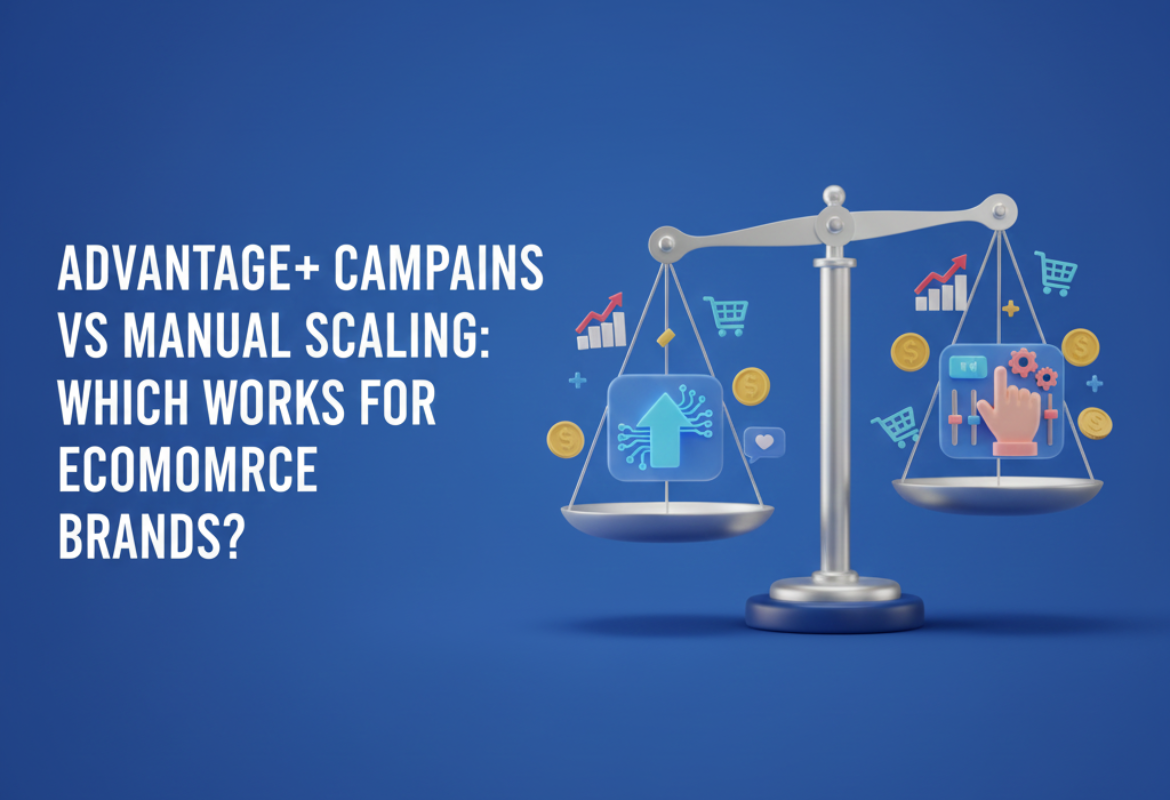
The debate between Advantage+ and manual scaling is not “either/or.” The most resilient ecommerce brands in 2025 are blending the two:
- Automation handles scale, speed, and efficiency.
- Manual strategies provide precision, learning, and brand control.
Think of Advantage+ as the engine that powers growth and manual scaling as the steering wheel that keeps campaigns aligned with strategy.
Conclusion: Which Works for Ecommerce Brands?
For ecommerce brands in 2025, both Advantage+ campaigns and manual scaling play vital roles.
- Advantage+ campaigns excel in scaling, speed, and efficiency. They’re ideal for larger budgets, international expansion, and acquisition-heavy goals.
Manual scaling shines where precision, control, and insight are critical smaller budgets, niche targeting, and retargeting funnels.
UK ecommerce businesses that learn to balance both approaches feeding AI with strong creative pipelines while retaining manual oversight for high-value segments will achieve the strongest growth.
Paid social is no longer about choosing between automation and control. It’s about using automation where it works best and applying human expertise where AI falls short.